It’s been suggested that “Hadoop” has become a buzzword, much like the broader signifier “big data”, and I’m inclined to agree. It could certainly be seen to fit Dan Ariely’s analogy of “Big data” being like teenage sex: “everyone talks about it, nobody really knows how to do it, everyone thinks everyone else is doing it, so everyone claims they are doing it”.
To recap, we’ve previously defined Hadoop as a “essentially an open-source framework for processing, storing and analysing data. The fundamental principle behind Hadoop is rather than tackling one monolithic block of data all in one go, it’s more efficient to break up & distribute data into many parts, allowing processing and analysing of different parts concurrently”.
In this article, we’re going to explore what Hadoop actually comprises- the essential components, and some of the more well-known and useful add-ons. At its core, Hadoop is comprised of four things:
- Hadoop Common- A set of common libraries and utilities used by other Hadoop modules.
- HDFS- The default storage layer for Hadoop.
- MapReduce- Executes a wide range of analytic functions by analysing datasets in parallel before ‘reducing’ the results. The “Map” job distributes a query to different nodes, and the “Reduce” gathers the results and resolves them into a single value.
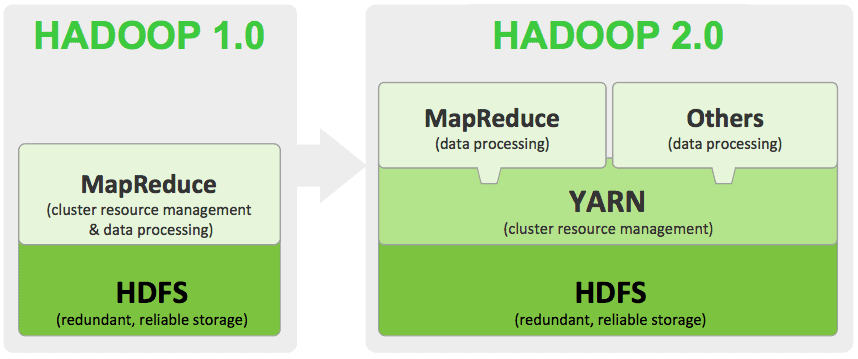
- YARN- Present in version 2.0 onwards, YARN is the cluster management layer of Hadoop. Prior to 2.0, MapReduce was responsible for cluster management as well as processing. The inclusion of YARN means you can run multiple applications in Hadoop (so you’re no longer limited to MapReduce), which all share common cluster management.
These four components form the basic Hadoop framework. However, a vast array of other components have emerged, aiming to ameliorate Hadoop in some way- whether that be making Hadoop faster, better integrating it with other database solutions or building in new capabilities. Some the more well-known components include:
- Spark- Used on top of HDFS, Spark promises speeds up to 100 times faster than the two-step MapReduce function in certain applications. Allows data to loaded in-memory and queried repeatedly, making it particularly apt for machine learning algorithms
- Hive- Originally developed by Facebook, Hive is a data warehouse infrastructure built on top of Hadoop. Hive provides a simple, SQL-like language called HiveQL, whilst maintaining full support for MapReduce. This means SQL programmers with little former experience with Hadoop can use the system easier, and provides better integration with certain analytics packages like Tableau. Hive also provides indexes, making querying faster.
- HBase- Is a NoSQL columnar database which is designed to run on top of HDFS. It is modelled after Google’s BigTable and written in Java. It was designed to provide BigTable-like capabilities to Hadoop, such as the columnar data storage model and storage for sparse data.
- Flume- Flume collects (typically log) data from ‘agents’ which it then aggregates and moves into Hadoop. In essence, Flume is what takes the data from the source (say a server or mobile device) and delivers it to Hadoop.
- Mahout- Mahout is a machine learning library. It collects key algorithms for clustering, classification and collaborative filtering and implements them on top of distributed data systems, like MapReduce. Mahout primarily set out to collect algorithms for implementation on the MapReduce model, but has begun implementing on other systems which were more efficient for data mining, such as Spark.
- Sqoop- Sqoop is a tool which aids in transitioning data from other database systems (such as relational databases) into Hadoop.
I hope this overview of various components helped to clarify what we talk about when we talk about Hadoop. When people talk about their use of Hadoop, they’re not referring to a single entity; in fact, they may be referring to a whole ecosystem of different components, both essential and additional.
More information about the ever-expanding list of Hadoop components can be found here.
(Image credit: Hortonworks)
Eileen McNulty-Holmes – Editor

Eileen has five years’ experience in journalism and editing for a range of online publications. She has a degree in English Literature from the University of Exeter, and is particularly interested in big data’s application in humanities. She is a native of Shropshire, United Kingdom.
Email: [email protected]
Interested in more content like this? Sign up to our newsletter, and you wont miss a thing!
[mc4wp_form]