Dataconomy
  • News
    • Artificial Intelligence
    • Cybersecurity
    • DeFi & Blockchain
    • Finance
    • Gaming
    • Startups
    • Tech
  • Industry
  • Research
  • Resources
    • Articles
    • Guides
    • Case Studies
    • Whitepapers
    • AI Models Leaderboard
  • AI toolsNEW
  • Newsletter
  • + More
    • Glossary
    • Conversations
    • Events
    • About
      • Who we are
      • Contact
      • Imprint
      • Legal & Privacy
      • Partner With Us
Subscribe
No Result
View All Result
  • AI
  • Tech
  • Cybersecurity
  • Finance
  • DeFi & Blockchain
  • Startups
  • Gaming
Dataconomy
  • News
    • Artificial Intelligence
    • Cybersecurity
    • DeFi & Blockchain
    • Finance
    • Gaming
    • Startups
    • Tech
  • Industry
  • Research
  • Resources
    • Articles
    • Guides
    • Case Studies
    • Whitepapers
    • AI Models Leaderboard
  • AI toolsNEW
  • Newsletter
  • + More
    • Glossary
    • Conversations
    • Events
    • About
      • Who we are
      • Contact
      • Imprint
      • Legal & Privacy
      • Partner With Us
Subscribe
No Result
View All Result
Dataconomy
No Result
View All Result

Google’s Social Learning: LLMs unite for collective knowledge

Within the Social Learning setup, "teacher" models convey knowledge to "student" models without the need to transmit sensitive or private information, striking a balance between effective learning and privacy preservation

byKerem Gülen
March 11, 2024
in Artificial Intelligence
Home News Artificial Intelligence
Share on FacebookShare on TwitterShare on LinkedInShare on WhatsAppShare on e-mail
Google Preferred Source

Google has rolled out an innovative AI framework termed “Social Learning,” designed to boost the collaborative prowess of language models while safeguarding user privacy. This new framework permits AI models to engage in natural language exchanges, sharing insights and enhancing their collective ability on diverse tasks without breaching privacy.

  • The concept draws inspiration from Bandura and Walters’ 1977 theory of social learning, emphasizing learning through observation, either by verbal instruction or by mimicking observed behaviors.
  • Unlike traditional collaborative learning methods that may involve direct data sharing, this approach enables LLMs to teach and learn from each other using natural language, circumventing privacy concerns.
  • The paper discusses the framework’s application across various tasks, including spam detection, solving grade school math problems, and text-based question answering, showcasing its versatility.

“Large language models (LLMs) have significantly improved the state of the art for solving tasks specified using natural language, often reaching performance close to that of people. As these models increasingly enable assistive agents, it could be beneficial for them to learn effectively from each other, much like people do in social settings, which would allow LLM-based agents to improve each other’s performance.”

-Google

How does Google’s Social Learning work?

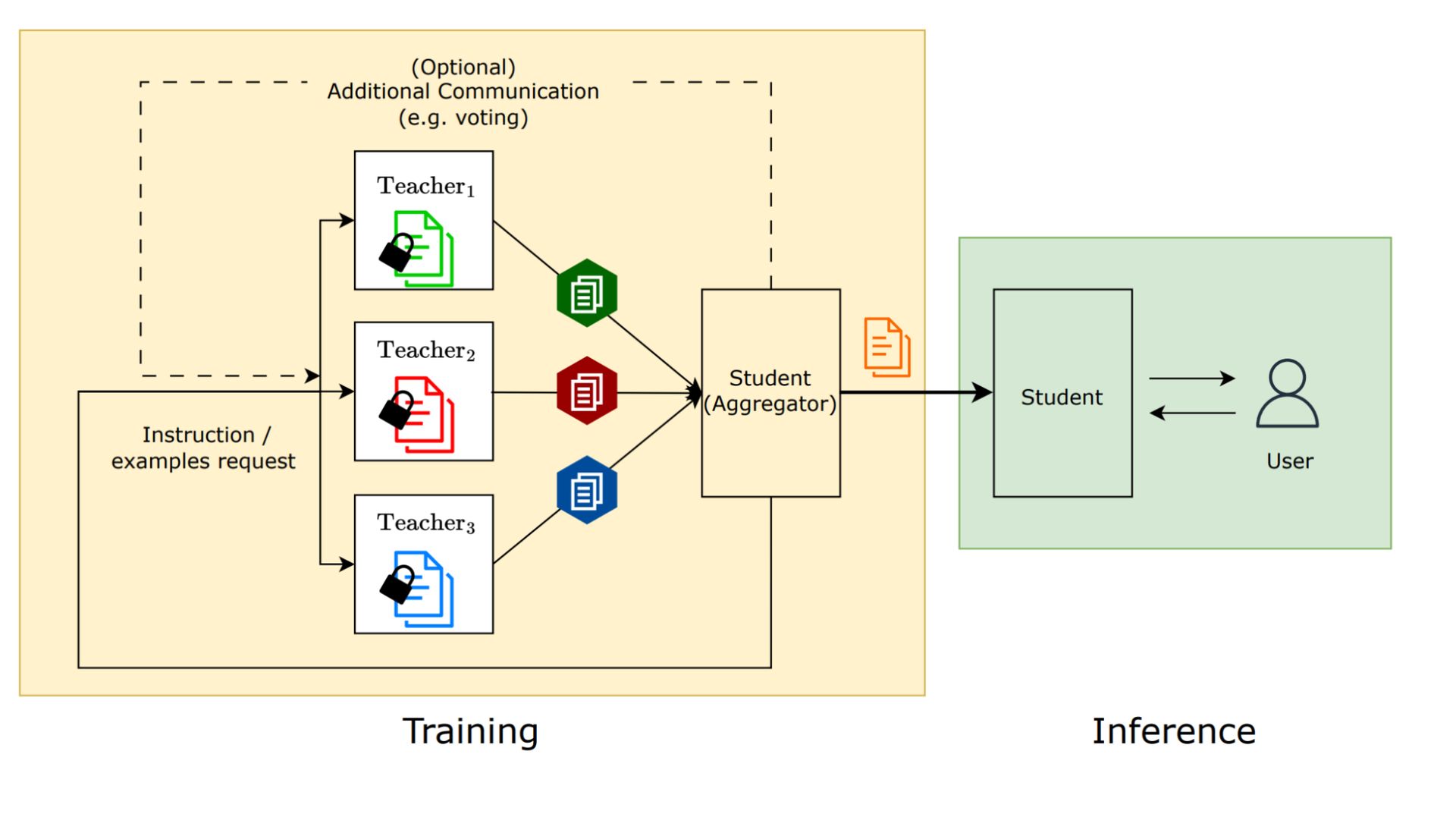
Within the Social Learning setup, “teacher” models convey knowledge to “student” models without the need to transmit sensitive or private information, striking a balance between effective learning and privacy preservation. These student models draw lessons from a variety of teacher models, each specialized in particular tasks like detecting spam, solving mathematical puzzles, or providing answers based on textual content.

By utilizing examples vetted by humans, teacher models can educate student models without exchanging the original data, thereby addressing the privacy concerns linked to data sharing. Furthermore, teacher models have the ability to craft new scenarios or create specific task instructions, enriching the educational journey.
Stay Ahead of the Curve!

Don't miss out on the latest insights, trends, and analysis in the world of data, technology, and startups. Subscribe to our newsletter and get exclusive content delivered straight to your inbox.

google social learning
Within the Social Learning setup, “teacher” models convey knowledge to “student” models without the need to transmit sensitive or private information (Image credit)

Research trials underscore the success of social learning in elevating student models’ competencies across a range of tasks. The synthetic scenarios concocted by teacher models have been found just as impactful as the authentic data, all while drastically diminishing privacy hazards. Likewise, task instructions fashioned by teacher models have been instrumental in boosting student model performances, showcasing the language models’ versatility in adhering to directives.

To anchor privacy protection, the research community has adopted measures like the Secret Sharer metric to evaluate the extent of data exposure during the learning phase. The findings reveal negligible privacy data seepage, validating the framework’s capacity to instruct without divulging details from the original data pool.


How AI improves education with personalized learning at scale and other new capabilities


By emulating the human process of social learning, these models are adept at exchanging know-how and collectively advancing their capabilities, all while prioritizing user privacy. This strategy opens new avenues for the creation of privacy-conscious AI technologies across varied fields. Looking ahead, the research teams are set on further polishing the Social Learning framework and delving into its utility in assorted tasks and data contexts.

google social learning
By emulating the human process of social learning, these models are adept at exchanging know-how and collectively advancing their capabilities (Image credit)

“We introduced a framework for social learning that allows language models with access to private data to transfer knowledge through textual communication while maintaining the privacy of that data. In this framework, we identified sharing examples and sharing instructions as basic models and evaluated them on multiple tasks. Furthermore, we adapted the Secret Sharer metric to our framework, proposing a metric for measuring data leakage,” Google stated in its blog post.

“As next steps, we are looking for ways of improving the teaching process, for example by adding feedback loops and iteration. Furthermore, we want to investigate using social learning for modalities other than text,” the blog post further reads.


Featured image credit: Mitchell Luo/Unsplash

Tags: AIartificial intelligenceGoogle

Related Posts

ByteDance launches Doubao 2.1 Pro language model

ByteDance launches Doubao 2.1 Pro language model

June 24, 2026
OpenAI expands cybersecurity efforts with Patch the Planet

OpenAI expands cybersecurity efforts with Patch the Planet

June 24, 2026
Claude Tag brings shared AI assistant to Slack channels

Claude Tag brings shared AI assistant to Slack channels

June 24, 2026
Getty Images partners with OpenAI to supply licensed visuals for ChatGPT

Getty Images partners with OpenAI to supply licensed visuals for ChatGPT

June 23, 2026
Samsung adopts ChatGPT Enterprise and Codex across global workforce

Samsung adopts ChatGPT Enterprise and Codex across global workforce

June 22, 2026
OpenAI improves health responses for free ChatGPT users

OpenAI improves health responses for free ChatGPT users

June 19, 2026

LATEST NEWS

Rockstar confirms GTA 6 pricing and pre-order details

ByteDance launches Doubao 2.1 Pro language model

OpenAI expands cybersecurity efforts with Patch the Planet

Meta launches $299 smart glasses under its own brand

Claude Tag brings shared AI assistant to Slack channels

PlayStation 6 leak points to 2027 release window

BEST AI MODELS LEADERBOARD

See the best AI models, ranked by intelligence, benchmark results, speed and token price. Find the most suitable LLMs, Text-to-Image, Image Editing, Text-to-Speech, Text-to-Video and Image-to-Video  artificial intelligence model for your tasks and business.

LATEST TOOLS

Vrew

Fireflies

SpeedLegal

Teachable Machine

Unriddle

VidAU

Qualified

character.ai

Interview Coder

Moonbeam

Dataconomy

COPYRIGHT © DATACONOMY MEDIA GMBH, ALL RIGHTS RESERVED.

  • About
  • Imprint
  • Contact
  • Legal & Privacy

Follow Us

  • News
    • Artificial Intelligence
    • Cybersecurity
    • DeFi & Blockchain
    • Finance
    • Gaming
    • Startups
    • Tech
  • Industry
  • Research
  • Resources
    • Articles
    • Guides
    • Case Studies
    • Whitepapers
    • AI Models Leaderboard
  • AI tools
  • Newsletter
  • + More
    • Glossary
    • Conversations
    • Events
    • About
      • Who we are
      • Contact
      • Imprint
      • Legal & Privacy
      • Partner With Us
No Result
View All Result
Subscribe

This website uses cookies to improve your experience. You can choose to accept or reject them. Visit our Privacy Policy.