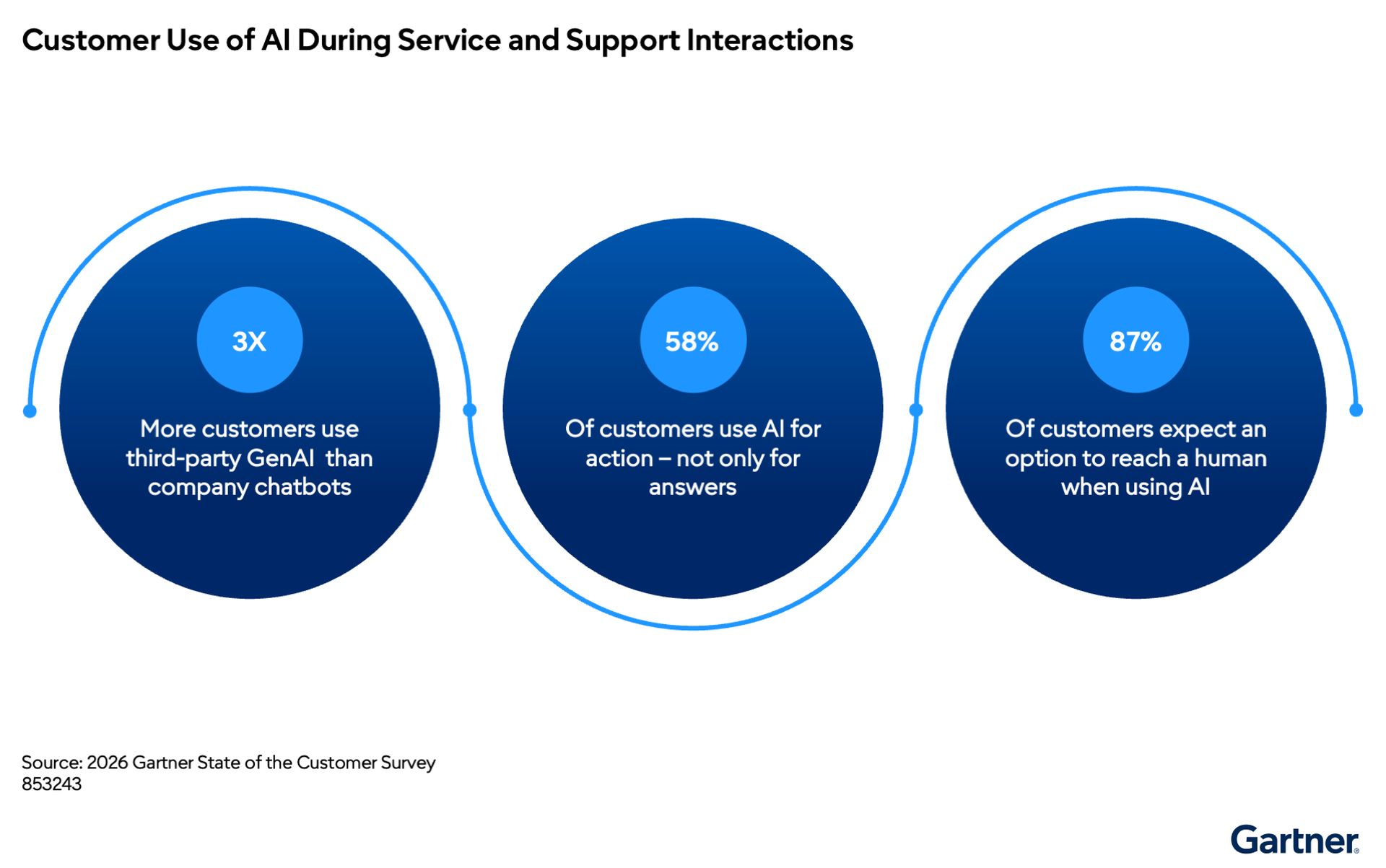
Customers are about 3 times more likely to use third-party generative AI tools than company-provided chatbots when trying to resolve customer service issues, according to a new Gartner survey.
The survey, conducted in February and March 2026, included 3,566 B2B and B2C customers. Gartner said the findings point to 3 major changes in customer behavior: customers are choosing third-party generative AI tools over company chatbots, using AI to complete tasks rather than only find answers, and expecting access to a human agent when companies use AI in customer service.
Eric Keller, senior director analyst in Gartner’s Customer Service & Support Practice, said customers are adopting generative AI in both personal and work settings, but that trend has not led to higher use of customer service chatbots provided by companies.
“Instead, GenAI is shifting some service interactions outside of company-owned channels,” Keller said.
Gartner said the use of third-party generative AI tools during service and support interactions has nearly doubled over the past year. Use of company-provided chatbots has remained statistically unchanged since 2022.
The firm said this weak adoption may help explain why many customer service organizations have not yet seen financial returns from their AI investments.
A separate Gartner survey of 1,303 senior leaders across multiple industries, conducted from January through April 2026, found that service and support leaders invested a median of 12 percent of their 2025 budgets in AI. Gartner said this was the highest share among the 10 business functions it assessed.
Despite that spending, only 24 percent of service and support leaders showed positive financial returns across their AI use cases.
Keller said the weak results from customer-facing generative AI investments are tied less to technology limits and more to a mismatch with customer expectations.
“Rather than investing primarily in standalone chatbots, organizations should focus on AI-enabled service journeys that help customers resolve issues across digital and voice channels,” Keller said.
Gartner said customers also expect generative AI to help them take action, not just answer questions. Among customers who use generative AI, 58 percent said they had used it to complete a task on their behalf. In B2B settings, that figure rose to 74 percent.
Keller said many company-provided chatbots are still mainly built to answer questions, while customers increasingly expect AI tools to help them complete actions such as booking appointments, submitting documents or updating accounts.
“Service and support leaders should redesign digital support around conversational, action-oriented experiences, rather than treating GenAI as a standalone chatbot,” Keller said.