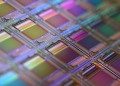
The nano-tech startup Diraq, in partnership with the European institute imec, has shown its silicon-based quantum chips maintain high accuracy when produced in a standard manufacturing setting, a development for making quantum computers viable.
The collaboration between the UNSW Sydney startup and the nanoelectronics institute Interuniversity Microelectronics Centre (imec) demonstrated that Diraq’s quantum chips function with the same reliability when produced on a commercial semiconductor chip fabrication line as they do within the experimental conditions of a UNSW research laboratory. In a paper published in the journal Nature on September 24, the teams reported that devices designed by Diraq and fabricated by imec achieved a fidelity of over 99 percent in operations that involved two quantum bits, or “qubits.”
Andrew Dzurak, a UNSW Engineering Professor and the founder and CEO of Diraq, stated that prior to this work, it had not been established whether the lab-based fidelity of processors could be replicated in a manufacturing environment. “Up until now it hadn’t been proven that the processors’ lab‑based fidelity – meaning accuracy in the quantum computing world – could be translated to a manufacturing setting,” Dzurak said. He explained that the results from the collaboration with imec remove this uncertainty. “Now it’s clear that Diraq’s chips are fully compatible with manufacturing processes that have been around for decades.”
This result is a step toward Diraq’s quantum processors reaching what is known as utility scale. This term describes the point at which a quantum computer’s commercial value surpasses its operational cost. Reaching this goal is a key metric established by the Quantum Benchmarking Initiative, a program operated by the United States’ Defense Advanced Research Projects Agency (DARPA). The initiative is designed to evaluate whether Diraq and 17 other participating companies can meet the utility-scale threshold.
To solve problems beyond the capacity of today’s most advanced high-performance computers, utility-scale quantum computers will need to store and manipulate quantum information using millions of qubits. This large number is required to overcome the inherent errors associated with the fragile quantum state. “Achieving utility scale in quantum computing hinges on finding a commercially viable way to produce high‑fidelity quantum bits at scale,” Dzurak commented. The necessity for cost-effective, large-scale production of high-fidelity qubits is a central challenge in the field.
Silicon has emerged as a leading material for constructing quantum computers because it allows for the integration of millions of qubits onto a single chip. This material also works with the existing trillion-dollar microchip industry, utilizing the same methods that place billions of transistors on modern computer chips. “Diraq’s collaboration with imec makes it clear that silicon‑based quantum computers can be built by leveraging the mature semiconductor industry, which opens a cost‑effective pathway to chips containing millions of qubits while still maximizing fidelity,” Dzurak said.
Diraq had previously demonstrated that qubits fabricated in an academic laboratory could achieve high fidelity when performing two-qubit logic gates, which are fundamental building blocks for future quantum computers. A remaining question was whether this level of fidelity could be reproduced when qubits were manufactured in a semiconductor foundry environment. “Our new findings demonstrate that Diraq’s silicon qubits can be fabricated using processes that are widely used in semiconductor foundries, meeting the threshold for fault tolerance in a way that is cost‑effective and industry‑compatible,” Dzurak noted.
Before this achievement, Diraq and imec had already shown that qubits manufactured using CMOS processes—the same technology used for building everyday computer chips—could perform single-qubit operations with 99.9 percent accuracy. However, the more complex two-qubit operations, which are critical to reaching utility scale, had not yet been demonstrated with the required fidelity. The successful demonstration of two-qubit fidelity addresses this specific technical milestone. “This latest achievement clears the way for the development of a fully fault‑tolerant, functional quantum computer that is more cost effective than any other qubit platform,” said Dzurak.