Cognitive applications have become constant companions at our places of work. We expect smart systems to reduce repetitive workloads and support us in uncovering new Knowledge. As a result, data scientists and software engineers are applying various machine learning algorithms to finetune results and increase processing capabilities. At the same time, critics are ever more loudly calling for more transparency about how these cognitive applications actually function. Companies are also advised to not to manage their AI-driven application environment solely on technical grounds. Knowledge Graphs make data-driven applications more accessible to subject matter experts. More important still, they enable organizations to deliver more precise cognitive solutions in an agile way.
Bridge the gap between automation and transparency
Question and answer machines, knowledge discovery and recommendation engines are changing internal workflows, as well as product and service offerings. In order to provide these kinds of applications, you need to have appropriate content and have experts in natural language processing and machine learning as well as specialized software engineers. The precision of recommender engines or search results, however, can be better judged by subject matter experts. They should be allowed to contribute to the system’s intelligence.
Knowledge Graphs mimic how the human brain works and represent the knowledge domain you are dealing with. You create concepts and relate them to each other. This is used as a foundation for text-processing. Experts without any coding skills can adapt the data model that is central to a cognitive application.
Example of a knowledge graph
Cost Savings matter
Having subject matter experts on board when building cognitive applications is a strong argument, but first you need to establish a different work approach. Either way, the question is eligible: Does the benefit-cost ratio convince? The impact of increased data transparency across a company is substantial, but can be hardly put into numbers.
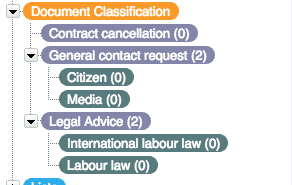
The latest implementation of a document classification system with PoolParty Semantic Suite has finally provided solid proof: Having a knowledge graph in place pays off. Imagine a service desk that has to handle thousands of customer support requests every day. Ideally, All incoming requests are classified correctly and forwarded to the right person. By classifying inbound documents with machine learning methods like support vector machines or deep learning, one typically reaches an F1 score (combining precision and recall) of around 90%. Extensive tests have shown that the combination of machine learning algorithms with semantic knowledge graphs can increase the F1 score by up to 3%, which is an overall improvement of over 5%.
Let’s assume that for every falsely forwarded document costs of 5 Euros/USD arise as additional people are then involved in the communication loop. Assuming that large organizations often need to classify 100,000 documents per month (or even more), an increased precision of 5% leads to yearly cost savings of 300.000 Euro (1,200.000 x €5.0 x 0.05 = € 300,000 per annum).
Deliver cognitive solutions faster
In practice, you might like to start working as early as possible with a cognitive solution. However, your machine learning algorithms depend on a quite extensive training data set. Including a knowledge graph also helps to reduce the quantity of data or documents needed to train a classifier successfully. The semantic layer adds features to a given data set that makes the development of cognitive solutions much more agile.
Be open-minded to combine technologies
We have entered a technology era where we need to focus on complementary solutions. When machine learning meets semantic technologies, you combine a quantitative with a qualitative-driven approach. You bring the best of both worlds together: The computing capacity of machines and the human knowledge and insights that are needed for specific use cases.
Learn more about semantic technologies at Data Natives
On the 16th and 17th of November the Data Natives conference takes place in Berlin. Join Nika Mizerski at her talk “Semantic Technologies: How to make cognitive solutions even smarter”. Nika will explore the potential of combining machine learning and semantic technologies and provide you with implementation insights.
Like this article? Subscribe to our weekly newsletter to never miss out!