Dataconomy
  • News
    • Artificial Intelligence
    • Cybersecurity
    • DeFi & Blockchain
    • Finance
    • Gaming
    • Startups
    • Tech
  • Industry
  • Research
  • Resources
    • Articles
    • Guides
    • Case Studies
    • Whitepapers
    • AI Models Leaderboard
  • AI toolsNEW
  • Newsletter
  • + More
    • Glossary
    • Conversations
    • Events
    • About
      • Who we are
      • Contact
      • Imprint
      • Legal & Privacy
      • Partner With Us
Subscribe
No Result
View All Result
  • AI
  • Tech
  • Cybersecurity
  • Finance
  • DeFi & Blockchain
  • Startups
  • Gaming
Dataconomy
  • News
    • Artificial Intelligence
    • Cybersecurity
    • DeFi & Blockchain
    • Finance
    • Gaming
    • Startups
    • Tech
  • Industry
  • Research
  • Resources
    • Articles
    • Guides
    • Case Studies
    • Whitepapers
    • AI Models Leaderboard
  • AI toolsNEW
  • Newsletter
  • + More
    • Glossary
    • Conversations
    • Events
    • About
      • Who we are
      • Contact
      • Imprint
      • Legal & Privacy
      • Partner With Us
Subscribe
No Result
View All Result
Dataconomy
No Result
View All Result

Microsoft expands Phi line with new multimodal models

Phi-4-mini is a text-only model that incorporates 3.8 billion parameters and Phi-4-multimodal, is an enhanced version of Phi-4-mini, boasting 5.6 billion parameters

byKerem Gülen
February 27, 2025
in Artificial Intelligence, News
Home News Artificial Intelligence
Share on FacebookShare on TwitterShare on LinkedInShare on WhatsAppShare on e-mail
Google Preferred Source

Microsoft Corp. has expanded its Phi line of open-source language models with the introduction of two new algorithms designed for multimodal processing and hardware efficiency: Phi-4-mini and Phi-4-multimodal.

Phi-4-mini and Phi-4-multimodal features

Phi-4-mini is a text-only model that incorporates 3.8 billion parameters, enabling it to run efficiently on mobile devices. It is based on a decoder-only transformer architecture, which analyzes only the text preceding a word to determine its meaning, thus enhancing processing speed and reducing hardware requirements. Furthermore, Phi-4-mini utilizes a performance optimization technique known as grouped query attention (GQA) to decrease hardware usage associated with its attention mechanism.


Microsoft Phi-4 AI tackles complex math with 14B parameters

Stay Ahead of the Curve!

Don't miss out on the latest insights, trends, and analysis in the world of data, technology, and startups. Subscribe to our newsletter and get exclusive content delivered straight to your inbox.


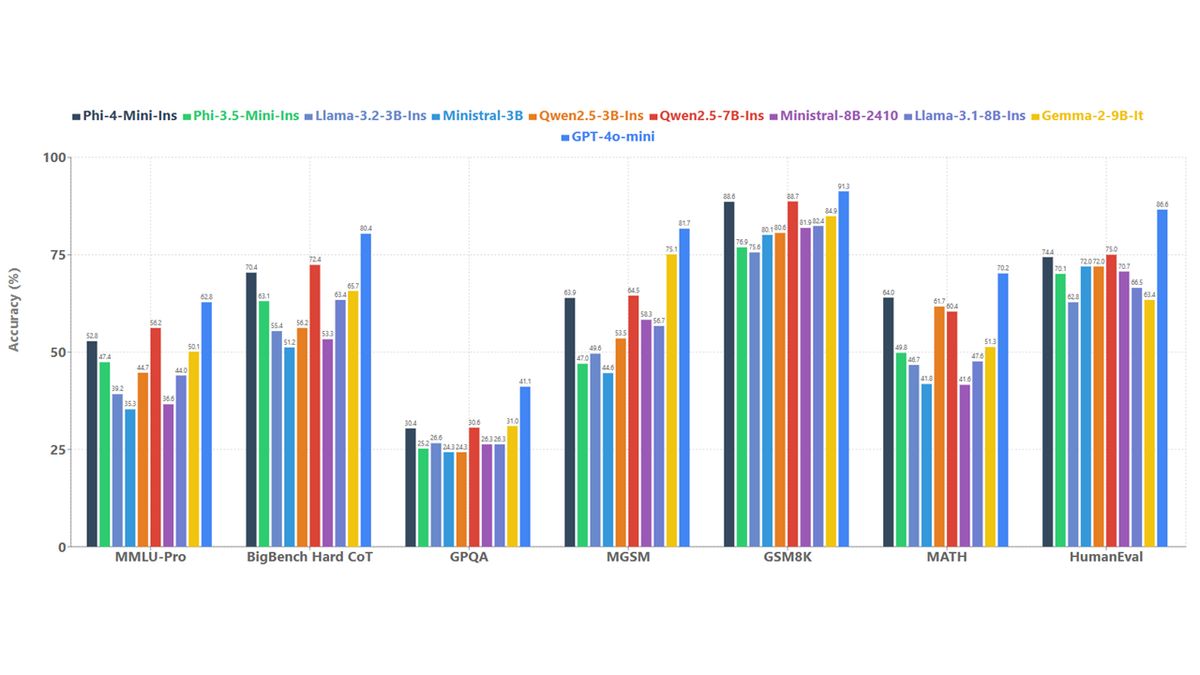
This model is capable of generating text, translating documents, and executing actions within external applications. Microsoft claims Phi-4-mini excels in tasks requiring complex reasoning, such as mathematical computations and coding challenges, achieving significantly improved accuracy in internal benchmark tests compared to other similarly sized language models.

The second model, Phi-4-multimodal, is an enhanced version of Phi-4-mini, boasting 5.6 billion parameters. It is capable of processing text, images, audio, and video inputs. This model was trained using a new technique called Mixture of LoRAs, which optimizes the model’s capabilities for multimodal processing without extensive modifications to its existing weights.
Microsoft expands Phi line with new multimodal models
Image: Microsoft

Microsoft conducted benchmark tests on Phi-4-multimodal, where it earned an average score of 72 in visual data processing, just shy of OpenAI’s GPT-4, which scored 73. Google’s Gemini Flash 2.0 led with a score of 74.3. In combined visual and audio tasks, Phi-4-multimodal outperformed Gemini-2.0 Flash “by a large margin” and surpassed InternOmni, which is specialized for multimodal processing.

Both Phi-4-multimodal and Phi-4-mini are licensed under the MIT license and will be made available through Hugging Face, allowing for commercial use. Developers can access these models through Azure AI Foundry and NVIDIA API Catalog to explore their potential further.

Phi-4-multimodal is particularly designed to facilitate natural and context-aware interactions by integrating multiple input types into a single processing model. It includes enhancements such as a larger vocabulary, multilingual capabilities, and improved computational efficiency for on-device execution.

Phi-4-mini delivers impressive performance in text-based tasks, including reasoning and function-calling capabilities, enabling it to interact with structured programming interfaces effectively. The platform supports sequences up to 128,000 tokens.

Furthermore, both models have undergone extensive security and safety testing, led by Microsoft’s internal Azure AI Red Team (AIRT), which assessed the models using comprehensive evaluation methodologies that address current trends in cybersecurity, fairness, and user safety.

Customization and ease of deployment are additional advantages of these models, as their smaller sizes allow them to be fine-tuned for specific tasks with relatively low computational demands. Examples of tasks suitable for fine-tuning include speech translation and medical question answering.

For further details on the models and their applications, developers are encouraged to refer to the Phi Cookbook available on GitHub.


Featured image credit: Microsoft

Tags: Microsoft

Related Posts

OpenAI improves health responses for free ChatGPT users

OpenAI improves health responses for free ChatGPT users

June 19, 2026
Adobe expands Firefly AI across Premiere, Illustrator, InDesign and Frame.io

Adobe expands Firefly AI across Premiere, Illustrator, InDesign and Frame.io

June 19, 2026
Spotify launches Reserved to give superfans early ticket access

Spotify launches Reserved to give superfans early ticket access

June 19, 2026
Google discontinues Nest Home Mini and Nest Audio

Google discontinues Nest Home Mini and Nest Audio

June 19, 2026
Instagram adds unique captions for each carousel slide

Instagram adds unique captions for each carousel slide

June 19, 2026
Steam Next Fest sees one in five demos labeled for generative AI

Steam Next Fest sees one in five demos labeled for generative AI

June 17, 2026

LATEST NEWS

OpenAI improves health responses for free ChatGPT users

Adobe expands Firefly AI across Premiere, Illustrator, InDesign and Frame.io

Spotify launches Reserved to give superfans early ticket access

Google discontinues Nest Home Mini and Nest Audio

Instagram adds unique captions for each carousel slide

Steam Next Fest sees one in five demos labeled for generative AI

BEST AI MODELS LEADERBOARD

See the best AI models, ranked by intelligence, benchmark results, speed and token price. Find the most suitable LLMs, Text-to-Image, Image Editing, Text-to-Speech, Text-to-Video and Image-to-Video  artificial intelligence model for your tasks and business.

LATEST TOOLS

Novoresume

PolyAI

SeaArt

H2O.ai

Techpresso

Namecheap Free Logo Maker

Binaural Beats Factory

Lyricallabs

Jobscan

Vsub

Dataconomy

COPYRIGHT © DATACONOMY MEDIA GMBH, ALL RIGHTS RESERVED.

  • About
  • Imprint
  • Contact
  • Legal & Privacy

Follow Us

  • News
    • Artificial Intelligence
    • Cybersecurity
    • DeFi & Blockchain
    • Finance
    • Gaming
    • Startups
    • Tech
  • Industry
  • Research
  • Resources
    • Articles
    • Guides
    • Case Studies
    • Whitepapers
    • AI Models Leaderboard
  • AI tools
  • Newsletter
  • + More
    • Glossary
    • Conversations
    • Events
    • About
      • Who we are
      • Contact
      • Imprint
      • Legal & Privacy
      • Partner With Us
No Result
View All Result
Subscribe

This website uses cookies to improve your experience. You can choose to accept or reject them. Visit our Privacy Policy.