Dataconomy
  • News
    • Artificial Intelligence
    • Cybersecurity
    • DeFi & Blockchain
    • Finance
    • Gaming
    • Startups
    • Tech
  • Industry
  • Research
  • Resources
    • Articles
    • Guides
    • Case Studies
    • Whitepapers
    • AI Models Leaderboard
  • AI toolsNEW
  • Newsletter
  • + More
    • Glossary
    • Conversations
    • Events
    • About
      • Who we are
      • Contact
      • Imprint
      • Legal & Privacy
      • Partner With Us
Subscribe
No Result
View All Result
  • AI
  • Tech
  • Cybersecurity
  • Finance
  • DeFi & Blockchain
  • Startups
  • Gaming
Dataconomy
  • News
    • Artificial Intelligence
    • Cybersecurity
    • DeFi & Blockchain
    • Finance
    • Gaming
    • Startups
    • Tech
  • Industry
  • Research
  • Resources
    • Articles
    • Guides
    • Case Studies
    • Whitepapers
    • AI Models Leaderboard
  • AI toolsNEW
  • Newsletter
  • + More
    • Glossary
    • Conversations
    • Events
    • About
      • Who we are
      • Contact
      • Imprint
      • Legal & Privacy
      • Partner With Us
Subscribe
No Result
View All Result
Dataconomy
No Result
View All Result

Microsoft Phi-4 AI tackles complex math with 14B parameters

Microsoft claims that Phi-4 delivers improved mathematical reasoning abilities compared to its predecessors

byKerem Gülen
December 13, 2024
in Artificial Intelligence, News
Home News Artificial Intelligence
Share on FacebookShare on TwitterShare on LinkedInShare on WhatsAppShare on e-mail
Google Preferred Source

Microsoft has launched Phi-4, a new generative AI model boasting 14 billion parameters, designed to tackle complex mathematical problems efficiently. Announced on December 12, 2024, this model marks a significant advancement in AI technology amid a growing demand for efficient computing solutions. Phi-4 is currently accessible on Microsoft’s Azure AI Foundry for research purposes under a license agreement.

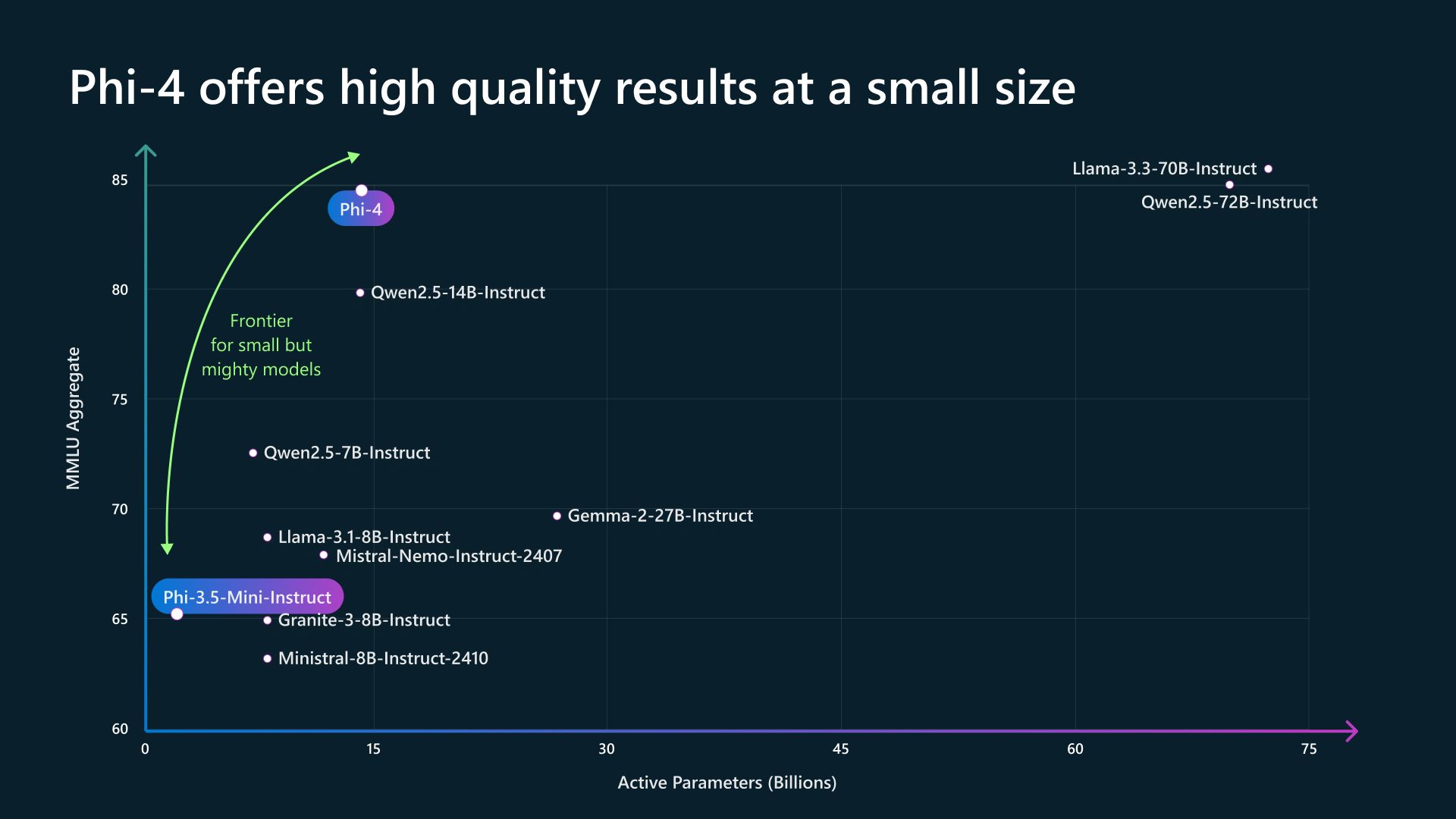
The Phi family of generative AI models aims to optimize performance while minimizing resource consumption. Microsoft claims that Phi-4 delivers improved mathematical reasoning abilities compared to its predecessors. The boost in performance stems from a combination of higher-quality training data and unspecified post-training enhancements. Compared to other smaller models like GPT-4o mini and Google’s Gemini 2.0 Flash, Phi-4 competes aggressively in functionality and speed while requiring fewer computational resources.Microsoft Phi-4 AI tackles complex math with 14B parameters

Phi-4’s efficiency challenges industry norms

Microsoft’s introduction of Phi-4 challenges the prevailing notion of “bigger is better” in AI model development. While other models, such as OpenAI’s GPT-4o and Google’s Gemini Ultra, operate with hundreds of billions of parameters, Phi-4 combines its streamlined architecture with superior performance in mathematical reasoning. This efficiency could shift the landscape of enterprise AI deployment, making advanced capabilities more accessible to businesses with limited computing budgets.
Stay Ahead of the Curve!

Don't miss out on the latest insights, trends, and analysis in the world of data, technology, and startups. Subscribe to our newsletter and get exclusive content delivered straight to your inbox.

Microsoft Phi-4 AI tackles complex math with 14B parameters
(Image: Microsoft)

There is growing interest in developing smaller, high-performing models capable of delivering competitive results without necessitating massive computational resources. This approach could benefit mid-sized companies that previously shied away from integrating large language models due to costs and complexity. The implications of Phi-4’s launch may ripple across various sectors, prompting organizations to reconsider their AI strategies.


Microsoft rolls out Copilot Vision that reads the web with you


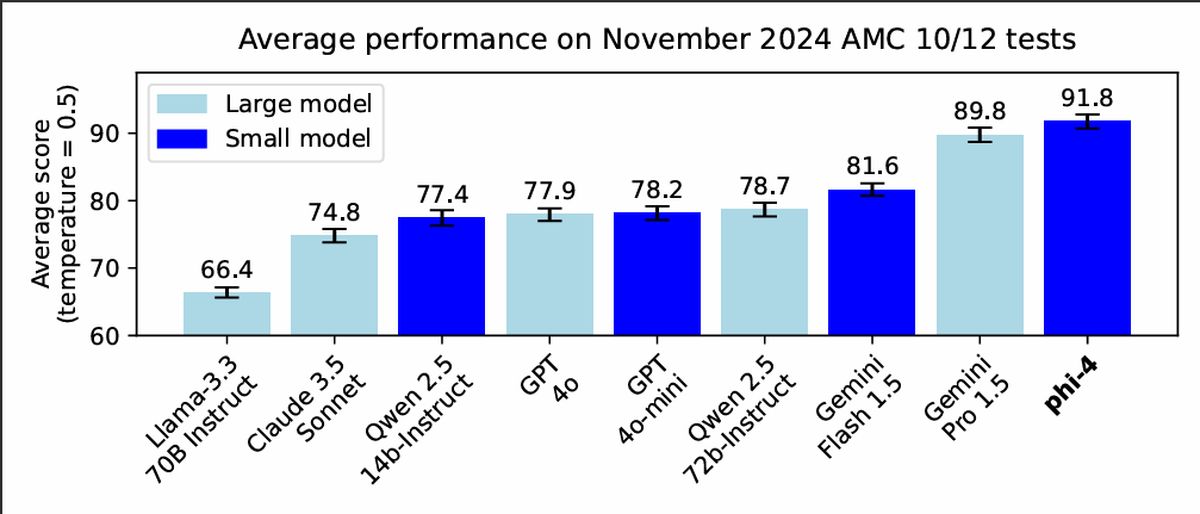
Phi-4 has shown exceptional aptitude in mathematical problem-solving. The model performed impressively on standardized tests such as the Mathematical Association of America’s American Mathematics Competitions (AMC). Results suggest that Phi-4 can frequently outpace both larger and smaller competitors in specialized tasks, indicating that targeted designs can yield significant advantages in specific areas, such as scientific research and engineering.
Microsoft Phi-4 AI tackles complex math with 14B parameters
(Image: Microsoft)

This specialized performance might prompt businesses to reassess the value of broader capabilities offered by larger models, favoring instead the precision and efficiency of something like Phi-4 in their applications. The ability to tackle rigorous mathematical challenges emphasizes its potential for diverse implementations in sectors where accuracy is paramount.

In its rollout, Microsoft is emphasizing safety and responsible AI development. Phi-4 is currently accessible on the Azure AI Foundry platform through a research license, with plans for a wider release in the future. This measured approach incorporates safety features and monitoring tools to address ongoing concerns surrounding AI risks.

Developers using the Azure AI Foundry have access to evaluation tools for assessing model quality and safety, as well as content filtering mechanisms to prevent potential misuse. Such steps signal a growing industry focus on risk management and ethical AI deployment as organizations increasingly look to integrate advanced technologies into their operations.


Featured image credit: Microsoft

Tags: FeaturedMicrosoft

Related Posts

“Free robots are an illusion”: Why we’ll pay for system intelligence, not delivery workers

“Free robots are an illusion”: Why we’ll pay for system intelligence, not delivery workers

June 12, 2026
How Henrique Schmaiske led Meteor.js through its biggest transformation

How Henrique Schmaiske led Meteor.js through its biggest transformation

June 12, 2026
Proven privacy: Why ‘no-log’ claims need real evidence today

Proven privacy: Why ‘no-log’ claims need real evidence today

June 12, 2026
ChatGPT hits 1 billion users as global AI adoption surges despite backlash

ChatGPT hits 1 billion users as global AI adoption surges despite backlash

June 12, 2026
Huawei launches HarmonyOS 7 developer beta with upgraded API 26

Huawei launches HarmonyOS 7 developer beta with upgraded API 26

June 12, 2026
OpenAI Codex referral program rewards users with extra rate resets

OpenAI Codex referral program rewards users with extra rate resets

June 12, 2026

LATEST NEWS

“Free robots are an illusion”: Why we’ll pay for system intelligence, not delivery workers

How Henrique Schmaiske led Meteor.js through its biggest transformation

Proven privacy: Why ‘no-log’ claims need real evidence today

ChatGPT hits 1 billion users as global AI adoption surges despite backlash

Huawei launches HarmonyOS 7 developer beta with upgraded API 26

OpenAI Codex referral program rewards users with extra rate resets

BEST AI MODELS LEADERBOARD

See the best AI models, ranked by intelligence, benchmark results, speed and token price. Find the most suitable LLMs, Text-to-Image, Image Editing, Text-to-Speech, Text-to-Video and Image-to-Video  artificial intelligence model for your tasks and business.

LATEST TOOLS

Roboto AI

Pickaxe

Pfpmaker

MindPal

Syllaby

ScreenApp

FinanceBrain

GitHub Spark

Hints

VisionStory AI

Dataconomy

COPYRIGHT © DATACONOMY MEDIA GMBH, ALL RIGHTS RESERVED.

  • About
  • Imprint
  • Contact
  • Legal & Privacy

Follow Us

  • News
    • Artificial Intelligence
    • Cybersecurity
    • DeFi & Blockchain
    • Finance
    • Gaming
    • Startups
    • Tech
  • Industry
  • Research
  • Resources
    • Articles
    • Guides
    • Case Studies
    • Whitepapers
    • AI Models Leaderboard
  • AI tools
  • Newsletter
  • + More
    • Glossary
    • Conversations
    • Events
    • About
      • Who we are
      • Contact
      • Imprint
      • Legal & Privacy
      • Partner With Us
No Result
View All Result
Subscribe

This website uses cookies to improve your experience. You can choose to accept or reject them. Visit our Privacy Policy.