Dataconomy
  • News
    • Artificial Intelligence
    • Cybersecurity
    • DeFi & Blockchain
    • Finance
    • Gaming
    • Startups
    • Tech
  • Industry
  • Research
  • Resources
    • Articles
    • Guides
    • Case Studies
    • Whitepapers
    • AI Models Leaderboard
  • AI toolsNEW
  • Newsletter
  • + More
    • Glossary
    • Conversations
    • Events
    • About
      • Who we are
      • Contact
      • Imprint
      • Legal & Privacy
      • Partner With Us
Subscribe
No Result
View All Result
  • AI
  • Tech
  • Cybersecurity
  • Finance
  • DeFi & Blockchain
  • Startups
  • Gaming
Dataconomy
  • News
    • Artificial Intelligence
    • Cybersecurity
    • DeFi & Blockchain
    • Finance
    • Gaming
    • Startups
    • Tech
  • Industry
  • Research
  • Resources
    • Articles
    • Guides
    • Case Studies
    • Whitepapers
    • AI Models Leaderboard
  • AI toolsNEW
  • Newsletter
  • + More
    • Glossary
    • Conversations
    • Events
    • About
      • Who we are
      • Contact
      • Imprint
      • Legal & Privacy
      • Partner With Us
Subscribe
No Result
View All Result
Dataconomy
No Result
View All Result

How dangerous news spreads: What makes Twitter users retweet risk-related information

byadmin
March 19, 2020
in Articles, Case Studies
Home Resources Articles
Share on FacebookShare on TwitterShare on LinkedInShare on WhatsAppShare on e-mail
Google Preferred Source

Scientists uncover how information related to potential dangers can spread on social media and how this can be prevented.

In Japan, a country prone to various natural and man-made calamities, users often turn to social media to spread information about risks and warnings. However, to avoid spreading rumors, it is crucial to recognize reliable sources of information. In a new study, researchers from Osaka University, Japan have revealed the mechanism by which risk-related information is disseminated on Twitter.

In an Internet-driven world, social media has become the go-to source of all kinds of information. This is especially relevant in crisis-like situations, when warnings and risk-related information are actively circulated on social media. But currently, there is no way of determining the accuracy of the information. This has occasionally resulted in the spread of misinformation, with some readers often bearing the brunt. In a study published in Japanese Psychological Research, scientists at Osaka University, including Prof Asako Miura, found a pattern through which information spreads on social media—which could help prevent the spread of fake news. Prof Miura says, “Dissemination of information through social media is often associated with false rumors. In order to prevent this, we wanted to unravel the underlying mechanisms by digging deeper into how these false rumors spread.”
Stay Ahead of the Curve!

Don't miss out on the latest insights, trends, and analysis in the world of data, technology, and startups. Subscribe to our newsletter and get exclusive content delivered straight to your inbox.

How dangerous news spreads: What makes Twitter users retweet risk-related information

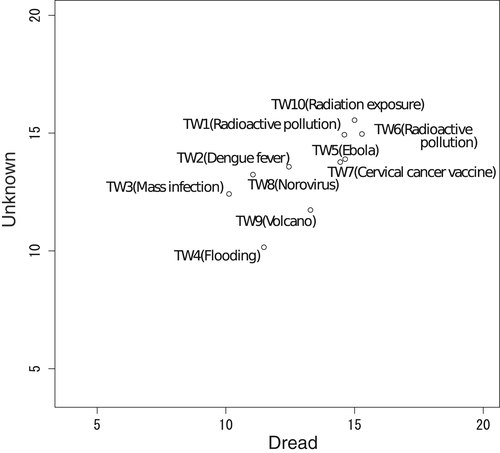
The scientists focused on Twitter, a popular site where users can disseminate or share information through the “retweet” feature. Conventional models of information diffusion fail to adequately explain the exact transmission route on social media, as they do not take into account individual user characteristics. Therefore, to study these characteristics, the scientists first selected 10 highly retweeted (more than 50 times) risk-related tweets. Based on Slovic’s well-known definition of risk perception, a cognitive model used to assess how people perceive certain risks, they assessed whether users perceived these risks as “dreadful” (related to large-scale events with potentially dire consequences) or “unknown” (when the impact of the event is unknown). They then analyzed the personal networks of the users who tweeted/retweeted particular tweets—specifically the number of followers, followees, and mutual connections.

They found that users with fewer connections tend to spread information arbitrarily, possibly owing to a lack of experience or awareness. But, users with a high number of mutual connections were more emotionally driven—they were more likely to spread dreadful information, possibly intending to share their reactions with the public. Prof Miura explains, “Our study showed the existence of an information diffusion mechanism on social media that cannot be explained by conventional theoretical models. We showed that risk perception has a significant impact on the ‘retweetability’ of tweets.”

By identifying the user network characteristics on Twitter, this study potentially offers a solution to prevent fake news dissemination. These characteristics can be leveraged to maximize the spread of accurate information, ensuring that appropriate measures are taken. Prof Miura concludes, “Our research provides an opportunity for people to rethink how false information is spread and to deliver accurate information via social media.”

The article, “Spread of risk information through microblogs: Twitter users with more mutual connections relay news that is more dreadful” was published in Japanese Psychological Research at DOI: https://doi.org/10.1111/jpr.12272.

Authors: Masashi Komori, Asako Miura, Naohiro Matsumura, Kai Hiraishi, and Kazutoshi Maeda

DOI: https://doi.org/10.1111/jpr.12272

Funded by: Japan Society for the Promotion for Science

Tags: surveillance

Related Posts

What 53,000 Churches Reveal About the Digital Transformation of Faith Communities

What 53,000 Churches Reveal About the Digital Transformation of Faith Communities

June 19, 2026
Xenco Medical wins back-to-back honors with Fast Company’s 2026 World Changing Ideas Award and Time Magazine 2026 Impact Award

Xenco Medical wins back-to-back honors with Fast Company’s 2026 World Changing Ideas Award and Time Magazine 2026 Impact Award

June 17, 2026
Data Sovereignty and Document Security: Where Does the Data Actually Live?

Data Sovereignty and Document Security: Where Does the Data Actually Live?

June 15, 2026
How Public Web Data Can Strengthen Environmental Protection

How Public Web Data Can Strengthen Environmental Protection

June 10, 2026
How automation tools are being integrated into professional networking

How automation tools are being integrated into professional networking

May 31, 2026
Autonomous agentic UI orchestration for high-throughput enterprise ecosystems

Autonomous agentic UI orchestration for high-throughput enterprise ecosystems

May 31, 2026
Please login to join discussion

LATEST NEWS

PlayStation 6 leak points to 2027 release window

Samsung unveils UFS 5.0 storage for future Galaxy phones

Getty Images partners with OpenAI to supply licensed visuals for ChatGPT

Instagram for TV launches on Samsung TVs in the US

Valve opens Steam Machine reservations starting at $1,049

Apple releases iOS 27 beta 2 with new “Write with Siri” feature

BEST AI MODELS LEADERBOARD

See the best AI models, ranked by intelligence, benchmark results, speed and token price. Find the most suitable LLMs, Text-to-Image, Image Editing, Text-to-Speech, Text-to-Video and Image-to-Video  artificial intelligence model for your tasks and business.

LATEST TOOLS

Moonbeam

Charisma AI

Essay Writer by Papertyper

Slite

Wonderin AI

Spur

Stenography

Calldesk

MaxAI.me

PhotoRestore

Dataconomy

COPYRIGHT © DATACONOMY MEDIA GMBH, ALL RIGHTS RESERVED.

  • About
  • Imprint
  • Contact
  • Legal & Privacy

Follow Us

  • News
    • Artificial Intelligence
    • Cybersecurity
    • DeFi & Blockchain
    • Finance
    • Gaming
    • Startups
    • Tech
  • Industry
  • Research
  • Resources
    • Articles
    • Guides
    • Case Studies
    • Whitepapers
    • AI Models Leaderboard
  • AI tools
  • Newsletter
  • + More
    • Glossary
    • Conversations
    • Events
    • About
      • Who we are
      • Contact
      • Imprint
      • Legal & Privacy
      • Partner With Us
No Result
View All Result
Subscribe

This website uses cookies to improve your experience. You can choose to accept or reject them. Visit our Privacy Policy.