Point·E
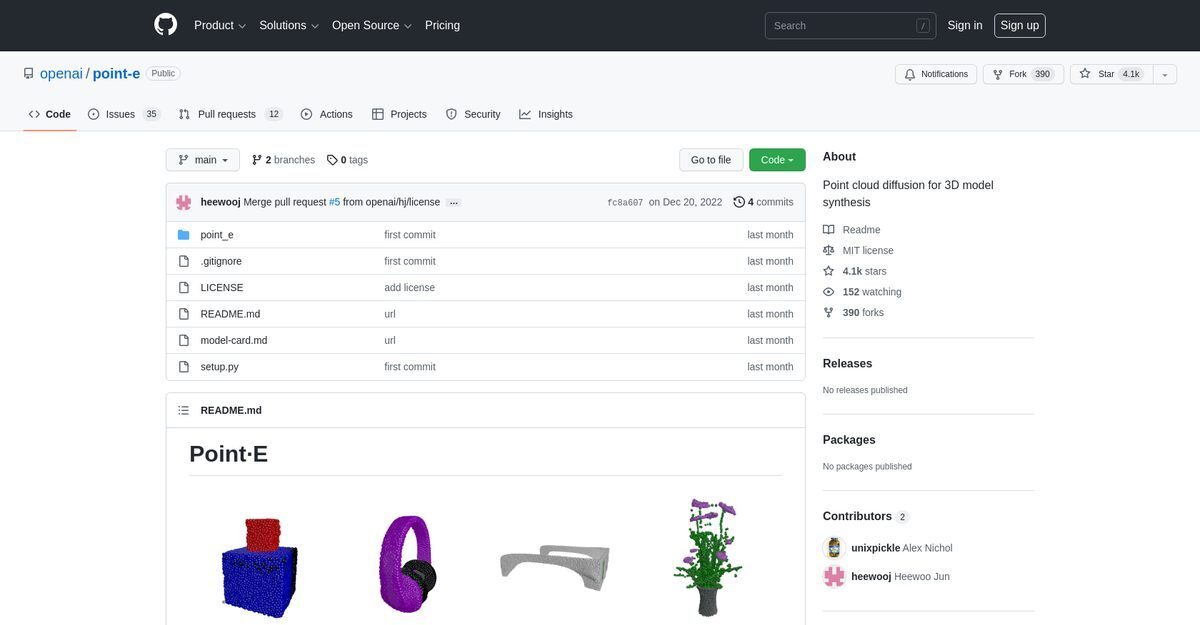
Point-E is an open-source AI system developed by OpenAI for generating 3D point clouds from complex text prompts or synthetic images using diffusion models, transforming them into detailed, realistic 3D models and meshes. It features a two-step diffusion process (text-to-image then image-conditioned point cloud generation), along with tools like text2pointcloud for direct text-to-3D and pointcloud2mesh using SDF regression for mesh conversion. Released under the MIT license on GitHub, it supports fast generation in 1-2 minutes on a single GPU, integrates with Jupyter notebooks, GitHub Actions, Codespaces, and tools like FiftyOne and Open3D for 3D workflows.
Pros
- Open source with MIT license
- GitHub Actions for automated workflows
- Instant development environments via Codespaces
- Highly detailed and realistic 3D models
- Fast generation in 1-2 minutes on single GPU
- Jupyter notebook compatibility with examples
- Active community with 4.1k stars and contributors
Cons
- Diffusion algorithm may be complex for beginners
- Detailed environment setup required
- Some features limited in quality for complex prompts
- Requires knowledge of GitHub and Python
- May over-complicate simpler 3D tasks
- Depends on external packages and dev environments
- Realism of models may vary
- No clear update schedule
Point-E is an AI tool developed by OpenAI for generating 3D point clouds from text prompts or images using diffusion models, creating detailed and realistic 3D outputs. It is open-source under the MIT license.
It uses a two-step diffusion model: text-to-image generation followed by image-conditioned point cloud diffusion, or direct text2pointcloud for simple shapes.
Clone the GitHub repository via HTTPS, GitHub CLI, or SVN, then run 'pip install -e .' and use setup.py for package installation.
Point-E employs diffusion algorithms with cosine schedules, 1024 timesteps, and supports pointcloud2mesh via SDF regression.
It is used for synthesizing 3D point clouds from text or images, converting to meshes, and building 3D datasets for applications like self-driving cars.
Compatible with Jupyter notebooks, GitHub Actions, Codespaces, FiftyOne for visualization, Open3D for format conversion, and Blender for rendering.
Outputs are highly detailed point clouds (e.g., 4096 points with RGB) and realistic 3D models, generated quickly on a GPU.
Released under the MIT license, allowing free use, modification, and distribution with copyright notice.
Yes, submit pull requests on GitHub after discussing major changes with maintainers; it has an active community.
Text-to-3D is limited to simple categories/colors with varying quality for complex prompts; requires Python/Jupyter setup.
Become a Contributor
Sign in to unlock these features:
- ⭐️ Rate this tool with a 1-5 star score
- ✍️ Write a detailed review for the community
- ❤️ Follow this tool to get important updates
Get started in seconds
[jnews_social_login_form]