Dataconomy
  • News
    • Artificial Intelligence
    • Cybersecurity
    • DeFi & Blockchain
    • Finance
    • Gaming
    • Startups
    • Tech
  • Industry
  • Research
  • Resources
    • Articles
    • Guides
    • Case Studies
    • Whitepapers
    • AI Models Leaderboard
  • AI toolsNEW
  • Newsletter
  • + More
    • Glossary
    • Conversations
    • Events
    • About
      • Who we are
      • Contact
      • Imprint
      • Legal & Privacy
      • Partner With Us
Subscribe
No Result
View All Result
  • AI
  • Tech
  • Cybersecurity
  • Finance
  • DeFi & Blockchain
  • Startups
  • Gaming
Dataconomy
  • News
    • Artificial Intelligence
    • Cybersecurity
    • DeFi & Blockchain
    • Finance
    • Gaming
    • Startups
    • Tech
  • Industry
  • Research
  • Resources
    • Articles
    • Guides
    • Case Studies
    • Whitepapers
    • AI Models Leaderboard
  • AI toolsNEW
  • Newsletter
  • + More
    • Glossary
    • Conversations
    • Events
    • About
      • Who we are
      • Contact
      • Imprint
      • Legal & Privacy
      • Partner With Us
Subscribe
No Result
View All Result
Dataconomy
No Result
View All Result

Data Improving Democracy

byEileen McNulty
June 6, 2014
in Articles, News, Trends
Home Resources Articles
Share on FacebookShare on TwitterShare on LinkedInShare on WhatsAppShare on e-mail
Google Preferred Source

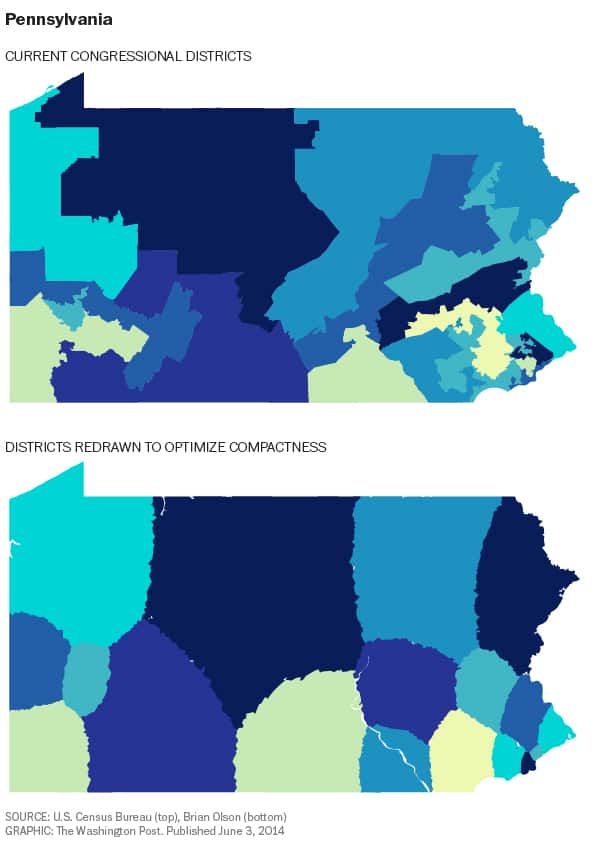
Gerrymandering in the US is a serious issue. The Washington Post estimates that as a result of gerrymandering, the Democrats under-represented by about 18 seats in the House, relative to their vote share in the 2012 election. Brian Olson, a software engineer from Massachusetts, has devised a programme which works out the most “optimally compact” districts based on 2010 census data, and avoids the need for human, politically-biased involvement in the drawing of district lines.

Brian Olson describes his methodology:

It looks at the boundaries between districts and tries to make things better by flipping one block from district A to district B (and possibly over some number of steps, other blocks from B to C and C to A). It doesn’t actually directly optimize the measure of population compactness, but looks at related measures like the ratio of the block’s distance to the average edge blocks’ distances from each district’s center, and the ratio of the populations of the two districts the block might go into. Each district grabs up to one block, then centers are recalculated and the cycle begins again checking all the edge blocks.

In practice, compare the current congressional district map of Pennsylvania to the redrawn, optimised districts below:
pa-map (1)

Of course, the idea is not without its drawbacks. Some argue compactness is not the best measure of quality districts, and they should instead be drawn in respect of “communities of interest”, allowing for some kind common denominator among the voters in a given district. But what this common denominator could be almost anything- shared cultural background, economic interest, ethnic background, demographic similarity, political boundaries, geographic boundaries… The list goes on. Such a loose definition of what actually constitutes a “common interest” opens the door to some seriously creative interpretation by politicians looking to give their party the edge.

Another issue is the fact that the Voting Rights Acts stipulates the drawing of some majority-minority districts, which isn’t covered in Olson’s model. But, by concentrating minorities in one or two districts, it diminishes their impact in all of the others, in effect partially disenfranchising them. Once again, a politician could use this to concentrate a minority group who didn’t favour his party into one or two districts, if he was so inclined.

Communities of interest and minorities are important factors, which should not be ruled out. But whilst there is human involvement in the drawing of district lines, there is room for political bias. An entirely computer-based model is certainly food for thought.

Read more here.
Follow @DataconomyMedia


Interested in more content like this? Sign up to our newsletter, and you wont miss a thing!

[mc4wp_form]

Stay Ahead of the Curve!

Don't miss out on the latest insights, trends, and analysis in the world of data, technology, and startups. Subscribe to our newsletter and get exclusive content delivered straight to your inbox.

Tags: PoliticssurveillanceWeekly Newsletter

Related Posts

Claude Fable 5 free access extended until July 19

Claude Fable 5 free access extended until July 19

July 13, 2026
Samsung Galaxy Z TriFold 2 launch may be delayed

Samsung Galaxy Z TriFold 2 launch may be delayed

July 13, 2026
Apple to skip M6 Pro and Max chips, fast-tracks M7 lineup for AI focus

Apple to skip M6 Pro and Max chips, fast-tracks M7 lineup for AI focus

July 13, 2026
OpenAI lifts GPT-5.6 Sol usage limits temporarily

OpenAI lifts GPT-5.6 Sol usage limits temporarily

July 13, 2026
OpenAI launches ChatGPT Work productivity app

OpenAI launches ChatGPT Work productivity app

July 10, 2026
Meta files patent for AI-powered emotional monitoring device

Meta files patent for AI-powered emotional monitoring device

July 10, 2026
Please login to join discussion

LATEST NEWS

Claude Fable 5 free access extended until July 19

Samsung Galaxy Z TriFold 2 launch may be delayed

Apple to skip M6 Pro and Max chips, fast-tracks M7 lineup for AI focus

OpenAI lifts GPT-5.6 Sol usage limits temporarily

OpenAI launches ChatGPT Work productivity app

Meta files patent for AI-powered emotional monitoring device

BEST AI MODELS LEADERBOARD

See the best AI models, ranked by intelligence, benchmark results, speed and token price. Find the most suitable LLMs, Text-to-Image, Image Editing, Text-to-Speech, Text-to-Video and Image-to-Video  artificial intelligence model for your tasks and business.

LATEST TOOLS

Mootion

Legacy AI

Copyseeker

ProPhotos

Kuki AI

Create

RemodelAI

AItwitch

Vadoo AI

Greptile AI

Dataconomy

COPYRIGHT © DATACONOMY MEDIA GMBH, ALL RIGHTS RESERVED.

  • About
  • Imprint
  • Contact
  • Legal & Privacy

Follow Us

  • News
    • Artificial Intelligence
    • Cybersecurity
    • DeFi & Blockchain
    • Finance
    • Gaming
    • Startups
    • Tech
  • Industry
  • Research
  • Resources
    • Articles
    • Guides
    • Case Studies
    • Whitepapers
    • AI Models Leaderboard
  • AI tools
  • Newsletter
  • + More
    • Glossary
    • Conversations
    • Events
    • About
      • Who we are
      • Contact
      • Imprint
      • Legal & Privacy
      • Partner With Us
No Result
View All Result
Subscribe

This website uses cookies to improve your experience. You can choose to accept or reject them. Visit our Privacy Policy.