Hacking Health Berlin, Charité University Hospital Berlin, the Berlin Institute of Health, Data Natives and Vision Health Pioneers brought together 164 participants, and 20 hacking teams that produced 14 community-sourced tech solutions to meet the COVID-19-related needs of Germany’s leading clinicians and researchers. Let’s take a look at the results.
“The Second World War showed us that you can train doctors in four years’ time, not seven…The coronavirus crisis is showing us it might be possible to have a vaccination in half the time. This is time to rethink the entire bureaucracy, the protocols around health”, said health innovator and entrepreneur Roi Shternin in his interview for Dataconomy.
Indeed, necessity is the mother of invention, and the crisis is a boost for change. COVID-19 is changing the face of healthcare globally, with more and more diverse technological solutions, experiments and open-source-based collaborations flowing into the industry. Delivering better health outcomes at a lower cost and supporting those on the frontline has been recognized as the crucial need to stop the spread and manage COVID-19 outbreak by global health institutions – for example, FDA decided to allow anti-malaria drugs to be tested to treat COVID-19 patients.
In Europe, the leading health institutions such as Charité University Hospital Berlin, the Berlin Institute of Health and the Diabetes Center Berne, Switzerland partnered up with health innovation movement Hacking Health Berlin, global data science community Data Natives, and Vision Health Pioneers – Berlin-based healthcare startup incubator, to bring together multidisciplinary professionals for an online hackathon to solve the real needs of the healthcare system.
The EasterHack took place on the weekend of Aril 10th and concluded on April 13th with a closing ceremony where five smartest hacking solutions were selected. Clinicians and experts fighting at the forefront at the Charité University Hospital Berlin joined the hackathon as mentors to support the teams in the development of the solutions.
The challenges, all based on the actual needs of the leading clinicians and researchers from Charité University Hospital Berlin, the Berlin Institute of Health and the Diabetes Center Berne, Switzerland, focused on supporting and protecting the high-risk population, protecting medical staff from getting infected, building on top of open-source solutions (such as CoEpi.org and COVID-watch.org) to allow privacy-first contact tracing, improving intensive care while reducing long-term lungs damage and support ICU patients psychologically & protecting healthcare workers’ and patients mental health.
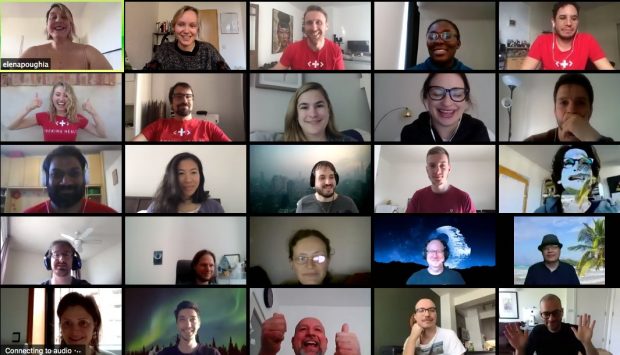
Over 200 enthusiasts stood up to these challenges, a total number of 164 participants of 26 nationalities formed 20 teams to spend their Easter holidays hacking from home intensively. They were supported by 35 mentors who worked tirelessly to direct the formation of innovative healthcare ideas and help turn them into actionable solutions – all through online video calls.
“Online mentoring allowed me to support a team in the Balkans. I could not have done that being based in Berlin without extensive travel”, says Maren Lesche, Head of Incubation at Vision Health Pioneers, EasterHack partner and mentor.
At the end of the hacking sessions, 14 pitches were introduced to the committee of 10 jurors – healthcare innovators, thinkers, researchers, and experts. Finally, 5 winners emerged.
THM – The health manager team tackled the manager dilemma for knowledge transfer during and post-corona times. There is a huge amount of research out there about many topics that will become relevant for the post-coronavirus crisis management. The restoration and innovation of healthcare systems, the preparation for future pandemics and more. A more direct transfer between researchers and practitioners is necessary to get a clearer picture on the status quo. THM team decided to pack 10.000 research papers and/or articles directly in the pockets of GPs, the public and hospital workers, allowing them to get their relevant questions answered in the format of short video snippets and visual graphics – all done with the help of a hybrid of curated information and deep learning engine.
“We came with an idea, started by pivoting it and now we moved 500% forward. We are so impressed by the quality of the participants and the mentors”, says Daniela Marzavan from ‘The Health Manager’ team.
Team mAIndcraft created a video-based hotline to provide instant psychological support for healthcare professionals exposed to stress and moral dilemmas during the COVID-19 pandemic. During the pandemic, healthcare professionals are not only exposed to high risk of infection but also to high mental distress due to uncertainty, moral dilemmas. Characterized by high workflow and restricted time, they lack the capacity to reach out to existing psychosocial support structures. By bringing psychological support to healthcare professionals directly via a video chat hotline, the instant psychological support was made possible by the voluntary commitment of a broad network of psychotherapists.
MyCare team developed a platform where all frontline healthcare workers can do regular health self-checks and get the support of qualified personnel to ensure that their total health is prioritized. While using the platform, healthcare workers are asked a set of questions as a form of self-assessment. Their answers are then assessed by a qualified team of experts, who determine the health state of the HCW and recommend timely interventions, including psychologist visits (in-person or digitally), scheduled breaks. This data, if allowed to be shred by a HCW, will serve as a tool for assessing the impact of pandemics on the overall health of HCW and will allow creating well-informed preventative measures.
contribute2.us team tackled the problem of the distribution of critical resources and services. Coronavirus has disrupted supply chains around the world. In some cases, there are still plenty of resources available, but these resources are not arriving at the locations that need them the most. Many people have critical resources sitting on their shelves at home but have no clear idea of where to send them. Thus, the resources remain unused. How contribute2.us solved it? By creating a platform where people can easily indicate where to send the resources (address), what is needed (ex: “We need 100 n95 masks”) and track the progress for the resource collection (ex: “We have received 37 of the 100 requested n95 masks. Thank you so much!”). On the other hand, the platform will allow providing a way to discover these requests based on the supplies they already have.
Last but not least, reCOVer team focused on the privacy-first contact tracing and digital epidemiology challenge by creating a multi-service platform connecting patients to self-assessment tools, dashboards, and personal analytics. Their vision is to enable patients to answer questions about their symptoms, location, and see recommended actions. Users will be able to easily track their logins on their phones and see how symptoms are changing. The secure and anonymous contact tracing will allow patients to stay in the know of their area and avoid potential high impact areas. Finally, information like location, age, and test results will be collected and anonymized into a large database for understanding the effects of the pandemic better.
Even though it is difficult to think of the pandemic bringing good into our lives, one thing is clear – more efficient and effective ways to deliver healthcare worldwide are being implemented as we speak, diverse communities and leading medical institutions are working together, and it’s not going away anytime soon.