Procurement is often one of the last major business functions to move beyond email chains, spreadsheets, and fragmented approval processes. In large organizations operating across multiple divisions, this lack of centralization can slow purchasing cycles, weaken oversight, duplicate requests, and limit opportunities to negotiate better supplier terms.
In this article, I examine the development of a centralized procurement management system integrated with SAP MM for an international industrial enterprise.
Abstract
The article is devoted to the development and implementation of a corporate procurement management system, integrated with SAP MM, for an industrial enterprise. It examines the specifics of the transition from a decentralized procurement model to a centralized automated platform providing end-to-end management of the procurement cycle. It is shown that the implementation of the system made it possible to reduce request processing times, improve compliance with approval regulations, and reduce costs through the consolidation of purchases. A conclusion is drawn regarding the practical effectiveness of centralized digitalization of procurement processes for enterprises with a distributed organizational structure.
Keywords: procurement, Procurement System, digital transformation, SAP MM, business process automation, request approval, corporate information systems, supplier management, project management, procurement consolidation.
Introduction
The procurement function occupies a special position within the structure of corporate business processes: on the one hand, it directly affects product cost and operating margin; on the other, it is a zone of heightened risk in terms of compliance with approval regulations, transparency of spending, and prevention of abuse [1]. In large organizations with a distributed branch structure, the procurement function often remains one of the last areas to be covered by digitalization: while production and financial processes are automated first, requests for the purchase of materials and services continue to be drawn up in free form — by email, as internal memos, or as Excel files passed manually along a chain of approving parties. This model gives rise to a number of systemic problems: the absence of a single point of control over a request’s status, the inability to consolidate the procurement needs of several departments in order to obtain volume discounts from suppliers, lengthy and non-transparent approval cycles, and difficulties in conducting internal audits of procurement activity [2].
This article is based on experience gained participating in a project to create and subsequently modernize a corporate Procurement System for a division of an international industrial holding specializing in the production and supply of industrial gases. The author performed the role of functional consultant, responsible for designing request approval processes, integrating the system with the SAP MM module, and drawing up technical specifications for the development team.
Theoretical foundations: Centralization and automation of procurement processes
In the supply chain management literature, a concept is highlighted describing the transition from tactical, operational purchasing to strategic procurement management, in which the procurement function is regarded not as administrative support but as a source of competitive advantage through the management of supplier relationships, volume consolidation, and reduction of transaction costs [3]. A key technological prerequisite for this transition is the implementation of e-procurement class systems, which provide for the electronic drafting, approval, and tracking of purchase requests. Studies of the implementation of such systems show that the main effect is achieved not so much through the acceleration of an individual transaction, but through increased transparency of data on the total volume of purchases in each product category, which creates a basis for negotiating with suppliers from a position of consolidated demand [4].
At the same time, the centralization of procurement processes carries organizational risks: strengthened control from the central office is often perceived by regional divisions as a loss of operational autonomy, which requires a well-considered change management strategy and phased implementation demonstrating quick wins at the initial stages [5].
Initial state of the procurement process
At the start of the project, the procurement process in the division under consideration was organized as follows. An employee in need of materials or services would draw up a request in free text form and send it by email to their direct manager. After verbal or written approval, the request was forwarded to the procurement department, where an employee manually transferred the data into an Excel register, searched for a supplier, and sent a request for a commercial quotation. After receiving the quotation and its approval by senior management, a purchase order was created, which was manually entered into the SAP MM system for further materials movement.
The pre-project survey (Discovery phase) revealed the following quantitative characteristics of the initial process:
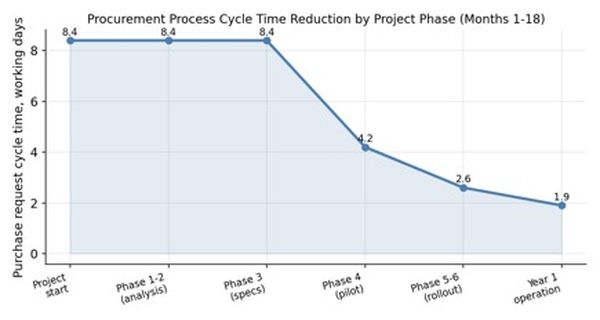
- The average processing time for a purchase request, from submission to the creation of a supplier order, was 8.4 working days;
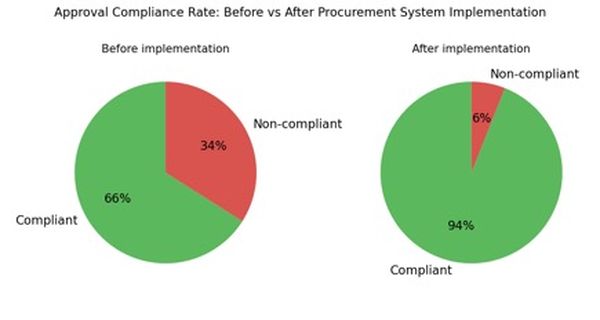
- 34% of requests were processed in violation of the established approval regulations — either without obtaining the required number of signatures, or with the standard review deadlines exceeded at one stage or another;
- There was no consolidation of purchases of similar materials between departments: up to 60% of requests for standard consumables were drawn up independently by different departments during the same period, which ruled out the possibility of obtaining volume discounts;
- The average time spent by procurement department staff searching for the status of a specific request (in response to queries from internal customers) was around 25 minutes per request, due to the need to review correspondence and Excel registers.
Phase 1. Analysis of procurement flows and categorization (Months 1–2)
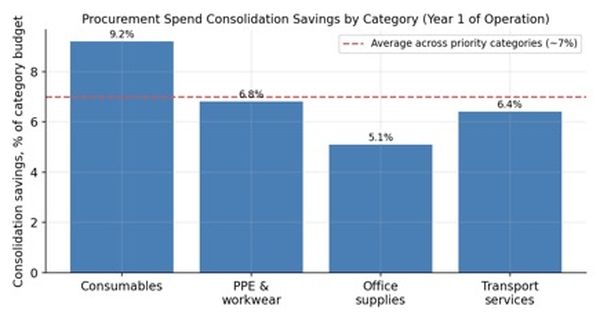
The first phase involved analyzing the structure of purchases over the preceding 24 months in order to identify the product categories in which consolidation could yield the greatest economic effect. Twelve consolidated procurement categories were identified, of which 4 categories (production consumables, protective clothing and PPE, office and stationery supplies, and transportation services) were designated as priorities for the first wave of system implementation.
Phase 2. Design of approval routes (Months 3–4)
At this stage, a matrix of request approval routes was developed, based on purchase amount, category, and initiating department. Eighteen standard approval routes were designed with automatic route determination based on request parameters, replacing the previous practice in which the approval route was determined informally, through personal arrangements between employees.
Phase 3. Development of functional specifications and integration with SAP MM (Months 5–8)
At this stage, functional specifications were prepared for the development team, including a description of the request submission interface, routing logic, master data validation rules, and the SAP MM integration scenario. Particular attention was paid to ensuring that the Procurement System did not exist as an isolated add-on, but was linked to the company’s core ERP system at the level of procurement documents, master data, and processing statuses.
As part of the design work, rules for creating purchase requisitions and purchase orders were defined, along with the logic for selecting between the PR → PO scenario and direct PO creation, as well as the mechanism for the return transfer of statuses from SAP MM to the Procurement System. Mandatory fields for transfer to SAP were defined: material code or service description, vendor, purchasing organization, purchasing group, plant, storage location, cost center, G/L account, account assignment category, quantity, unit of measure, delivery date, and price conditions.
In total, 21 functional descriptions were prepared, including 5 specifications for integration interfaces and 16 specifications for user screens and reporting forms. Additionally, a mapping matrix linking procurement categories to SAP MM/FI accounting objects was developed, which made it possible to connect the business classification of purchases with plant, storage location, cost center, and G/L account.
Technical architecture of the SAP MM integration
One of the key elements of the project was the integration of the corporate Procurement System with the SAP MM module, since the new system needed not only to automate the internal process of submitting and approving requests, but also to ensure the correct creation of procurement documents in the company’s core ERP system.
The integration scenario used standard SAP MM objects related to the process of purchasing materials and services: purchase requisition, purchase order, vendor master data, material master data, purchasing organization, purchasing group, plant, storage location, account assignment category, cost center, and G/L account. On the Procurement System side, a request was created as an internal approval business document, and after passing through all the necessary routes, it was transferred to SAP MM for the creation of a procurement document.
At the design stage, two possible scenarios were considered: creating a purchase requisition with subsequent conversion into a purchase order, and directly creating a purchase order once approval was complete. For priority procurement categories requiring additional review by the procurement department and the possibility of consolidating several requests, the PR → PO scenario was used. In this case, an approved request from the Procurement System was transferred to SAP MM as a purchase requisition, after which a procurement department specialist could combine several needs, select a supplier, and create a purchase order. For standard, recurring purchases with pre-defined suppliers, a simplified scenario of direct purchase order creation was applied once the approval route was complete.
The integration was built on a hybrid model. For synchronous validation of master data, RFC calls to SAP were used, making it possible to validate the existence of the material, vendor, plant, storage location, cost center, and G/L accounts prior to final approval of the request. For transferring approved requests and creating procurement documents, a middleware integration layer was used, converting data from the internal Procurement System format into a structure compatible with SAP MM objects. In cases requiring batch data transfer or the processing of large volumes of requests, asynchronous exchange via IDoc/file exchange was used, with subsequent status processing.
Particular attention was paid to the return transfer of statuses from SAP MM to the Procurement System. After the creation of a purchase requisition or purchase order, SAP returned the document number, processing status, information on document creation errors, and subsequent statuses related to order changes or closure. This allowed request initiators and approvers to track not only the internal approval status, but also the further progress of the request through the procurement process: request created in SAP, order created with the supplier, order changed, order closed, or document not created due to a data error.
Separate logic for monitoring integration messages was implemented to handle errors. Errors were divided into several categories: master data errors, routing errors, authorization errors, mandatory field errors, and technical exchange errors. For example, if a request specified an inactive material code, an incorrect cost center, a missing G/L account, or an invalid plant/storage location combination, the system would not allow the document to be transferred to SAP until the data was corrected. For technical errors, a mechanism for resending the message was provided once the cause of the failure had been resolved. All errors were logged in the integration log, with the time, error type, responsible user, and reprocessing status recorded.
A separate authorization model was designed as its own component. User access within the Procurement System was determined by their role in the procurement process: request initiator, department head, financial controller, procurement department specialist, master data administrator, and system administrator. For each role, rights were defined for creating, viewing, modifying, approving, rejecting, and resubmitting requests. The authorization model was also linked to the company’s organizational structure: a user could only view and process requests relating to their own department, cost center, plant, or area of responsibility. For approvers, routes were determined automatically based on purchase amount, category, initiating department, and cost type.
The connection between procurement categories and accounting objects was implemented through a mapping matrix. Each procurement category was linked to permitted material groups, account assignment categories, cost centers, G/L accounts, plants, and storage locations. This approach made it possible to reduce the number of errors when creating procurement documents in SAP MM and to ensure the correct reflection of costs in financial accounting. For example, requests for production consumables were automatically linked to the corresponding plant and storage location, while purchases of administrative services required the specification of a cost center and G/L account. For certain categories, additional budget validation rules and approval by a financial controller were also applied.
As a result, the integration of the Procurement System with SAP MM made it possible to eliminate double data entry, reduce the number of errors in the creation of procurement documents, and ensure a transparent link between the internal request approval process and the subsequent reflection of the purchase in the ERP system. This became one of the key factors in reducing request processing time and improving compliance with procurement process regulations.
Phase 4. Pilot implementation in priority categories (Months 9–11)
The system was launched in pilot mode for four priority procurement categories in one of the production divisions. During the pilot period, 412 requests were processed, of which 89% were fully processed through the new system without recourse to the previous channels (email, Excel).
Phase 5. Rollout to the remaining divisions and categories (Months 12–16)
Following the successful completion of the pilot, the system was progressively rolled out to the remaining divisions and product categories. During this stage, 56 defects and enhancement requests were identified, predominantly related to the specifics of individual divisions’ local regulations that had not been accounted for at the initial design stage.
Phase 6. Stabilization and development of consolidation reporting (Months 17–18)
At the final stage, analytical reports were configured, enabling the procurement department to view the aggregate volume of requests for each category in real time, which created the foundation for conducting centralized negotiations with key suppliers.
From fragmented requests to consolidated procurement demand
One of the most significant effects of the system’s implementation was the ability to aggregate the procurement needs of different divisions into a single picture of demand. Before the system was implemented, requests for similar materials (for example, consumables for production equipment) were submitted independently by different divisions, often addressed to different suppliers and at different prices, since no division had information indicating that a similar purchase was already underway or being planned in parallel elsewhere.
Following the implementation of the system, all requests in these categories now pass through a single processing point, which has enabled the procurement department to identify instances of parallel purchasing and consolidate them into single orders. Over the course of the system’s first year of operation, 47 instances of consolidation of parallel requests from different divisions into a single supplier order were recorded.
Economic effect of the implementation
Quantitative indicators recorded twelve months after the completion of the system’s rollout to all divisions demonstrated the following dynamics:
- The average processing time for a purchase request decreased from 8.4 to 1.9 working days;
- The share of requests processed in violation of approval regulations fell from 34% to 6%;
- Savings achieved through the consolidation of purchases amounted to approximately 7% of the division’s total procurement budget for priority categories;
- The average time spent by procurement department staff searching for a request’s status decreased from 25 minutes to less than 1 minute, thanks to the availability of a unified status-tracking interface;
- The share of requests fully processed through the system without recourse to email or Excel rose from 0% (at the project’s outset) to 94% by the end of the first year of operation.
Practical principles for building a corporate procurement system
Based on the experience gained in implementing this project, the following practical principles can be formulated, applicable to organizations with a distributed structure that are considering the centralization and automation of their procurement processes.
| Principle | Practical content |
| Analysis of historical data prior to launch | Categorizing past purchases makes it possible to identify priority areas where consolidation will yield the greatest effect, and to avoid spreading the project’s resources across all categories simultaneously. |
| Formalization of approval routes | Explicit definition of routes based on purchase amount and category eliminates informal practices and improves compliance with regulations. |
| Deep integration with ERP | Automatic creation of orders in SAP MM based on approved requests eliminates double data entry and the errors associated with it. |
| Alignment of business categories with the ERP accounting model | Procurement categories should be linked in advance to material groups, cost centers, G/L accounts, plants, and storage locations. This reduces the number of errors when creating documents in SAP MM and ensures the correct reflection of costs in financial accounting. |
| Pilot before rollout | Launching on a limited scale makes it possible to identify local process specifics before rolling the system out across the entire organization. |
| Status transparency for the requester | The ability for the request initiator to independently track its status reduces the workload on the procurement department and increases the satisfaction of internal customers. |
| Analytics as a negotiation driver | Consolidated demand data by category becomes a tool for centralized negotiations with suppliers on volume discounts. |
| Change management | Early involvement of regional divisions and the demonstration of quick wins reduce resistance to centralization. |
Conclusion
The experience of implementing this corporate Procurement System project confirms that automation of the procurement process delivers maximum effect when combined with deep integration into the core accounting system (in this case, SAP MM) and a well-designed matrix of approval routes reflecting the organization’s actual decision-making structure. The reduction in request processing time from 8.4 to 1.9 working days, the decrease in the rate of regulatory violations from 34% to 6%, and savings of approximately 7% of the procurement budget in priority categories demonstrate that investment in the digitalization of the procurement function delivers a measurable return, both in terms of operational efficiency and direct cost savings. The principles presented are applicable to organizations with a distributed branch structure that are considering a transition from decentralized procurement practices to a single automated platform.
References
- Monczka R. M., Handfield R. B., Giunipero L. C., Patterson J. L. Purchasing and Supply Chain Management. — 6th ed. — Boston: Cengage Learning, 2015. — 832 p.
- Croom S., Brandon-Jones A. Impact of e-Procurement: Experiences from Implementation in the UK Public Sector // Journal of Purchasing and Supply Management. — 2007. — Vol. 13, No. 4. — pp. 294–303.
- Kraljic P. Purchasing Must Become Supply Management // Harvard Business Review. — 1983. — Vol. 61, No. 5. — pp. 109–117.
- de Boer L., Harink J., Heijboer G. A Conceptual Model for Assessing the Impact of Electronic Procurement // European Journal of Purchasing & Supply Management. — 2002. — Vol. 8, No. 1. — pp. 25–33.
- Kotter J. P. Leading Change. — Boston: Harvard Business School Press, 1996. — 187 p.
- Lysons K., Farrington B. Procurement and Supply Chain Management. — 9th ed. — Harlow: Pearson, 2016. — 752 p.