The gap between how product teams want to work and how most tools let them work has become hard to ignore.
According to a 2025 survey of 1,000 knowledge workers, most product teams switch between apps and platforms an average of 33 times a day. There is usually a task tracker for sprint work, a separate wiki for specs and documents, a roadmap tool that lives somewhere else, and a communication layer running across all of it. None of these systems were designed to work together. Most were added one at a time, each solving one specific problem without thinking about what the full picture would look like.
The result is a pattern most product people will recognise. A product manager writes a spec in one tool, creates tasks in another, updates the roadmap in a third, and then finds out during the sprint review that the spec everyone was working from was an older version. Engineering had the right tasks but the wrong context. The handoff between product and development happened but some information got lost between the systems.
This is not a problem of working too slowly. The team is busy. They are just working in parallel on things that should be connected but are not.
What changed about the problem
For most of the past decade, the standard answer to product team tooling was to add more software. Jira for tasks. Confluence for documentation. A roadmap plugin for the timeline. A Slack integration to cut down on status meetings. The idea was that individual tools could be linked through integrations, and that switching between them was a fair trade-off for getting the best tool in each category.
That idea is now being questioned. That same research found that 79% of employees say their company has not taken any steps to reduce tool overload or bring platforms together. The integration model creates a different kind of problem: it spreads information across systems in ways that are hard to track, hard to keep up to date, and hard to explain to someone who is new. When a product spec lives in Confluence, tasks live in Jira, and the roadmap lives somewhere else, the connection between them only exists in the mind of the person who set it all up. Anyone joining the team has to figure out the logic from scratch.
What good product management software looks like now
The market has shifted toward tools that bring everything together. The platforms gaining ground among product teams are not the ones that do any single thing better than older specialist tools. They are the ones that remove the gaps between categories entirely.
Good product management software in 2026 connects roadmaps, sprints, and documentation inside one workspace. When a spec is updated, the tasks connected to it reflect that change. When a sprint is planned, the team does not need to check a separate roadmap to understand priorities. When an engineer wants to know why a task exists, the context is one click away not three tools away.
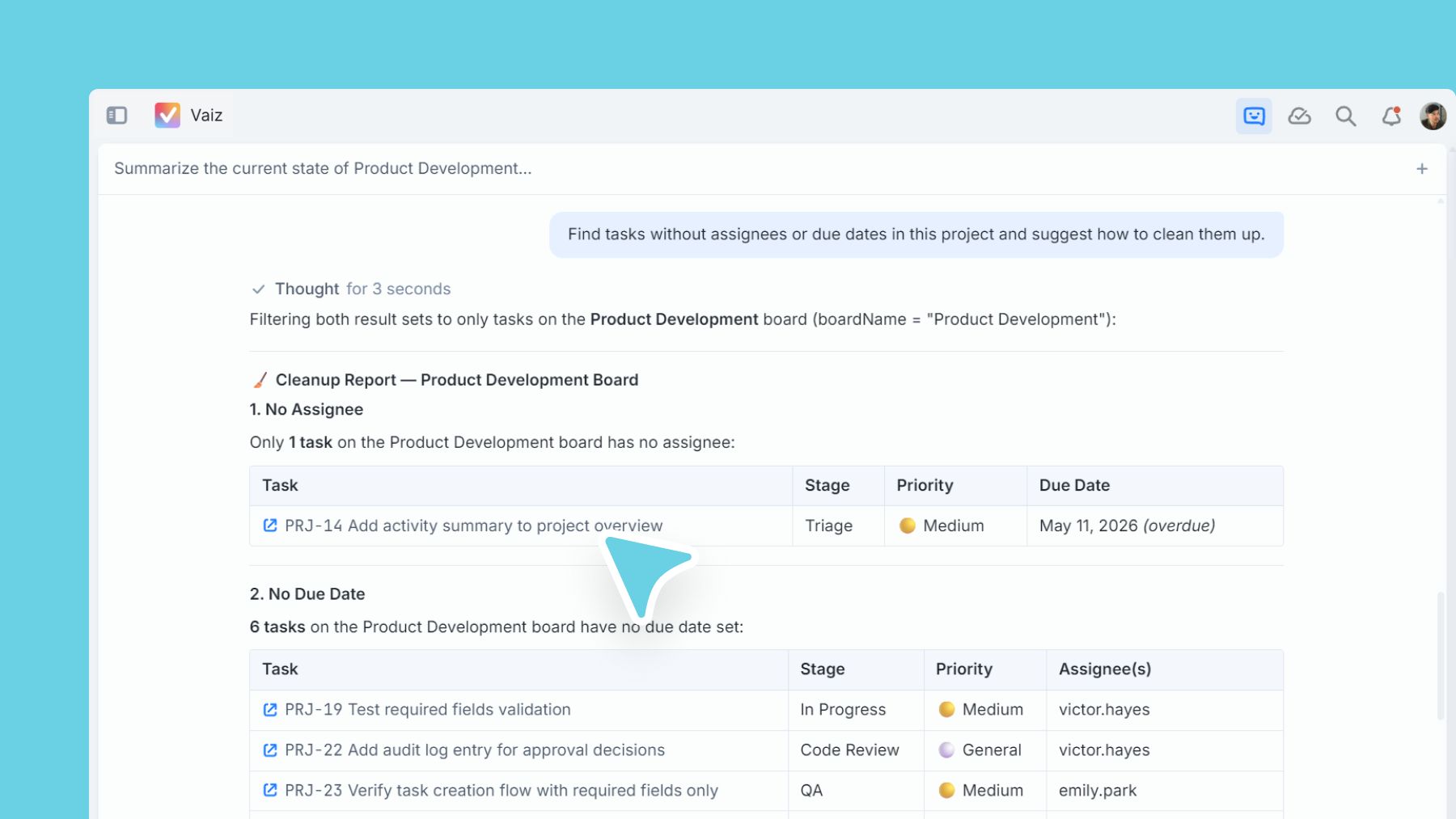
That connected structure also changes how AI can help inside a team. When tasks, specs, and roadmap items all live in the same system, an AI assistant has real context to work with. It can help write a product requirements document based on existing tasks, summarise sprint progress without anyone feeding it information by hand, or spot blockers in a backlog without a separate status meeting. The value of AI in product work is not the model — it is the data it can access. A model that can only see a chat thread cannot help much with a sprint. One that reads the full workspace can.
In practice, this distinction matters more than most teams expect. An AI with access to the full workspace does not just answer questions — it can search across projects, create and update tasks, generate structured reports, and surface blockers without anyone feeding it information manually. The gap between a chat assistant and a context-aware AI agent is a function of data access, not model capability.
Vaiz is one platform built around this idea. It connects roadmaps, tasks, and documentation in a single interface, with sprint planning tools, Kanban and Scrum board support, and GitHub and GitLab integration so that pull requests link directly to the tasks they relate to. Design tools like Figma and Miro embed inside documents, so design context sits next to the spec rather than behind a separate link. Projects import directly from Jira, Asana, Notion, and other major platforms, and a Zapier integration extends connectivity to 9,000+ apps without writing any code. Vaiz AI operates as a full participant in that same workspace — it sees tasks, projects, and documents, and can create items, build reports, and map dependencies directly inside the platform, without switching tabs.
 The onboarding signal
A simple way to check whether a product tool is actually working well is to watch what happens when someone new joins the team.
In a setup with many disconnected tools, onboarding means giving access to four or five platforms, explaining where each type of information lives, and hoping the person remembers before the setup emails get buried. In a single connected workspace, the information has one location and one clear structure. A new hire can follow the trail from roadmap item to sprint task to technical spec without a long orientation session.
That onboarding difficulty is not just an inconvenience. It shows how much knowledge the team is carrying in people’s heads rather than in the tools knowledge that leaves every time someone does.
Where this is heading
The next shift in product management tools will likely come from how well systems can surface context, not just store it.
Teams already working in connected workspaces are starting to use AI to reduce the coordination work that usually falls on product managers: writing status updates, tracking blockers, turning notes into structured tasks, checking roadmap progress against sprint reality. The tools that will matter most in this next phase are not the ones with the most features. They are the ones where the right information is already in the right place for an AI layer to use.
For product teams managing work across several disconnected systems today, the question is no longer whether consolidation is worth it. It is whether the cost of switching is lower than the ongoing cost of losing context every week.