The year is 2026, and the digital landscape of leadership has reached a breaking point. For decades, the tech and business worlds have operated in”90s mode,” treating human identity like a product on a high-speed assembly line, something that should be polished, interchangeable, individually dispensable, and, above all, optimised for the algorithm, much like any other piece of content whose primary function is to be consumed and serve a purpose. And it is precisely this pursuit of permanent visibility that turned the very concept of “personal brand” into a deadly toy: a tool that promises influence but often results in a documented crisis of exhaustion. Everyone thought they were faking it until they made it, while instead they kept faking it until they burned out completely. We are witnessing a massive wave of systemic fatigue, stemming directly from the pressing need to perform personal brands so constantly that we allowed them to grind our authentic personalities into dust.
In an era of “Identity Capitalism,” where our very selves are commodified for engagement, the most radical act for a leader is no longer to be seen, but to be still.
Techism: Reclaiming the screen as a healing space
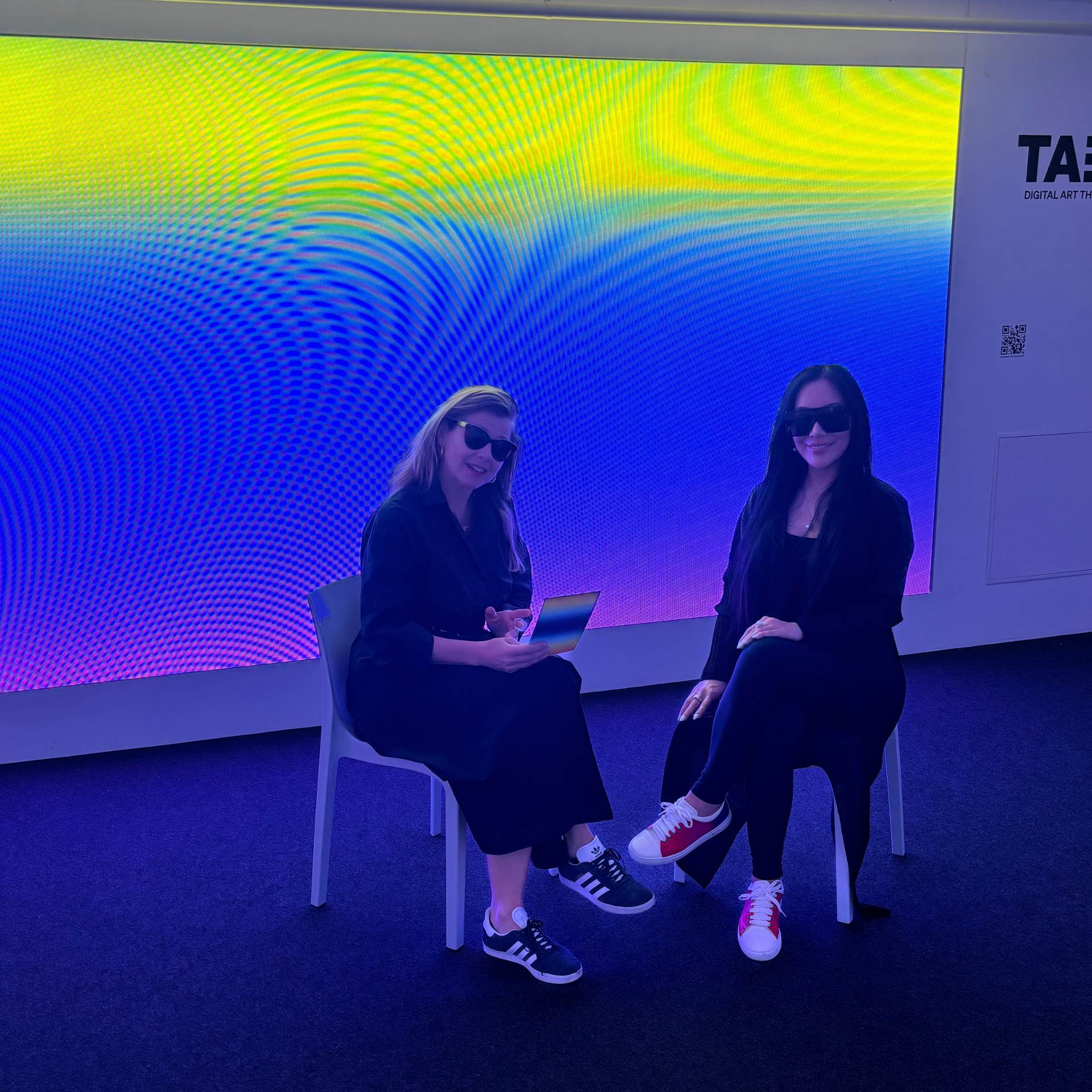
Two years ago, at Art Basel, I encountered a vision that offered a profound alternative to this noise, without going the route of dispensing with tech altogether. I sat down with artist Krista Kim to discuss her philosophy of “Techism” and her project “Mars House” (2020). an idea rooted in her “Techism Manifesto,” which frames technology and art not as opposing forces, but as companions shaping a new form of digital humanism. Mars House, which was the world’s first NFT digital dwelling, dematerialises architecture into light, color, and frequency. Often referred to as a “digital Rothko,” Kim’s work introduces the concepts of withdrawal and reduction into a world driven by loud visibility. What makes her approach essential for modern leadership is the shift from performance to presence: she uses technology not to lock in the viewer’s attention, like the vast majority of content creators, but to quiet it, to let it flow, by creating a digital environment in which one can simply be. For the tech industry, this is a vital lesson: technology should serve as a tool for digital wellness and emotional resonance, rather than a master that demands our attention.
The framework of slow positioning
In my work as a Story Advocate, I have found that, for leadership to be effective in an era of constant transformation, it is essential to move beyond the “Botox-Self” of curated personas. I call this approach Slow Positioning, in that it encourages deliberately slowing down, going against the grain of our “start-up” world, favouring an introspective identity process over marketing tactics.
To truly own one’s narrative in 2026, a leader must master the most difficult exercise: switching everything else off. Slow Positioning requires three radical steps to “cut the noise”.
Leaving the “Rabbit Hole” and the cycle of constant reaction. It means muting the “background noise of evaluation” generated by algorithms and stepping back conscious that, even for a moment, nobody is looking and nobody needs to be looking.
Distinguishing between the interchangeable narratives forced upon us by the market and our true biographical truth. This process of “decluttering” allows us to discard what no longer serves our integrity.
Shifting the focus from external impact back to inner coherence. True authority arises in the moments when we stop staging ourselves and start clarifying our “Being”.
Humanizing technology through relational intelligence
Leadership in the age of AI and the Metaverse requires radical self-acceptance. As machines take over analytical tasks, the human core of leadership, which resides in relational intelligence, becomes the only true differentiator. This is the ability to build authentic, trust-based relationships, which is impossible to any leader who chooses to stay hidden behind a mask of strategic performance.
Engaging with art like Krista Kim’s or communities like Data Natives is a survival strategy, in this sense. It helps leaders reconnect to their own stories, allowing them to lead with presence instead of pressure. Once a leader stops treating their career as an image project and starts treating it as an experience, they regain their sovereignty over their own role.
Conclusion: Reclaiming the narrative
Digital sovereignty in 2026 lies in the power to pull the plug. It is the ability to step back, disconnect from the constant background noise of evaluation, and return to the digital space on your own terms. Once you own your story, you gain the freedom to use platforms as functional tools for connection rather than as measures of self-worth. The question is no longer how deep you can go into the digital landscape. The question is whether you still have the clarity to find your way out and reclaim your own narrative.
About the author
Dr. Caroline Harth is a Story Advocate and author of Own Your Story, based in Venice and Berlin. She helps leaders and organisations navigate the complexities of digital transformation by reclaiming their authentic narratives through the principles of Slow Positioning and Relational Intelligence. At Dataconomy, she writes about art, design, and storytelling in the context of digital culture and emerging technologies. Her work explores how these shifts are reshaping identity, presence, and narrative in contemporary society. Because stories are, ultimately, data with a soul.