Dataconomy
  • News
    • Artificial Intelligence
    • Cybersecurity
    • DeFi & Blockchain
    • Finance
    • Gaming
    • Startups
    • Tech
  • Industry
  • Research
  • Resources
    • Articles
    • Guides
    • Case Studies
    • Whitepapers
  • AI toolsNEW
  • Newsletter
  • + More
    • Glossary
    • Conversations
    • Events
    • About
      • Who we are
      • Contact
      • Imprint
      • Legal & Privacy
      • Partner With Us
Subscribe
No Result
View All Result
  • AI
  • Tech
  • Cybersecurity
  • Finance
  • DeFi & Blockchain
  • Startups
  • Gaming
Dataconomy
  • News
    • Artificial Intelligence
    • Cybersecurity
    • DeFi & Blockchain
    • Finance
    • Gaming
    • Startups
    • Tech
  • Industry
  • Research
  • Resources
    • Articles
    • Guides
    • Case Studies
    • Whitepapers
  • AI toolsNEW
  • Newsletter
  • + More
    • Glossary
    • Conversations
    • Events
    • About
      • Who we are
      • Contact
      • Imprint
      • Legal & Privacy
      • Partner With Us
Subscribe
No Result
View All Result
Dataconomy
No Result
View All Result

Researchers warn of 100K-node botnet exploiting Remote Desktop vulnerabilities

GreyNoise researchers uncovered a botnet using over 100,000 IPs to attack RDP services in the U.S. starting October 8. The botnet uses timing and login enumeration attacks to identify valid Windows usernames.

byAytun Çelebi
October 14, 2025
in Cybersecurity, News
Home News Cybersecurity
Share on FacebookShare on TwitterShare on LinkedInShare on WhatsAppShare on e-mail

A multi-country botnet using over 100,000 IP addresses began targeting Remote Desktop Protocol services in the United States on October 8. Researchers at threat monitoring platform GreyNoise are tracking this large-scale campaign, which they believe is launched by the extensive botnet.

Remote Desktop Protocol (RDP) is a network protocol that enables remote connection to and control of Windows systems. It is commonly utilized by administrators, helpdesk staff, and remote workers. Attackers frequently target the protocol by scanning for open RDP ports, attempting brute-force logins, exploiting vulnerabilities, or performing timing attacks to gain unauthorized access.

For this campaign, GreyNoise researchers found the botnet employs two specific RDP-related attack techniques to enumerate user accounts. The methods include:

Stay Ahead of the Curve!

Don't miss out on the latest insights, trends, and analysis in the world of data, technology, and startups. Subscribe to our newsletter and get exclusive content delivered straight to your inbox.

  • RD Web Access timing attacks: These probes measure response-time differences during anonymous authentication flows on RD Web Access endpoints to infer valid usernames.
  • RDP web client login enumeration: This technique interacts with the RDP Web Client login flow, observing differences in server behavior and responses to identify user accounts.

GreyNoise first detected the campaign after observing an unusual traffic spike from Brazil. Similar activity was then registered from Argentina, Iran, China, Mexico, Russia, South Africa, and Ecuador. According to the company, the full list of countries with compromised devices participating in the botnet now exceeds 100.
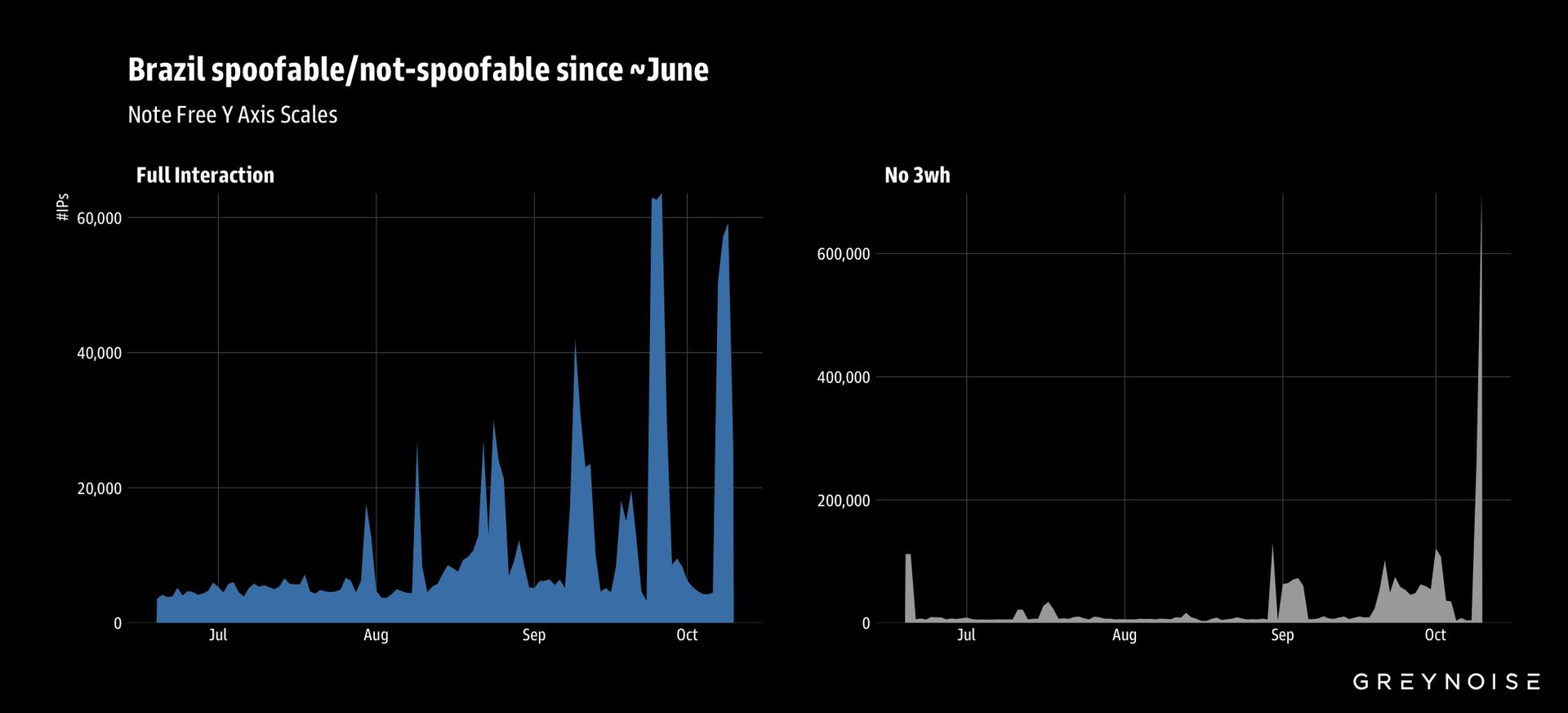
Researchers warn of 100K-node botnet exploiting Remote Desktop vulnerabilities
Image: GreyNoise

A technical analysis revealed that nearly all attacking IP addresses share a common TCP fingerprint. Although researchers noted variations in the Maximum Segment Size, they believe these differences are due to the various clusters of compromised machines that constitute the botnet infrastructure.

To defend against this activity, system administrators are recommended to block the IP addresses launching the attacks and to review system logs for suspicious RDP probing. As a general security best practice, RDP services should not be exposed directly to the public internet. Adding a VPN and multi-factor authentication (MFA) provides an additional layer of protection.



Featured image credit

Tags: botnetgreynoise

Related Posts

Google Workspace adds password-protected Office file editing

Google Workspace adds password-protected Office file editing

January 20, 2026
Claim: NVIDIA green-lit pirated book downloads for AI training

Claim: NVIDIA green-lit pirated book downloads for AI training

January 20, 2026
Tesla restarts Dojo3 supercomputer project as AI5 chip stabilizes

Tesla restarts Dojo3 supercomputer project as AI5 chip stabilizes

January 20, 2026
OpenAI targets “practical adoption” for 2026 strategy

OpenAI targets “practical adoption” for 2026 strategy

January 20, 2026
Nvidia hits 200 teraFLOP emulated FP64 for scientific computing

Nvidia hits 200 teraFLOP emulated FP64 for scientific computing

January 19, 2026
Walmart maintains Apple Pay ban in U.S. stores for 2026

Walmart maintains Apple Pay ban in U.S. stores for 2026

January 19, 2026

LATEST NEWS

Google Workspace adds password-protected Office file editing

Claim: NVIDIA green-lit pirated book downloads for AI training

Tesla restarts Dojo3 supercomputer project as AI5 chip stabilizes

OpenAI targets “practical adoption” for 2026 strategy

Nvidia hits 200 teraFLOP emulated FP64 for scientific computing

Walmart maintains Apple Pay ban in U.S. stores for 2026

Dataconomy

COPYRIGHT © DATACONOMY MEDIA GMBH, ALL RIGHTS RESERVED.

  • About
  • Imprint
  • Contact
  • Legal & Privacy

Follow Us

  • News
    • Artificial Intelligence
    • Cybersecurity
    • DeFi & Blockchain
    • Finance
    • Gaming
    • Startups
    • Tech
  • Industry
  • Research
  • Resources
    • Articles
    • Guides
    • Case Studies
    • Whitepapers
  • AI tools
  • Newsletter
  • + More
    • Glossary
    • Conversations
    • Events
    • About
      • Who we are
      • Contact
      • Imprint
      • Legal & Privacy
      • Partner With Us
No Result
View All Result
Subscribe

This website uses cookies. By continuing to use this website you are giving consent to cookies being used. Visit our Privacy Policy.