Dataconomy
  • News
    • Artificial Intelligence
    • Cybersecurity
    • DeFi & Blockchain
    • Finance
    • Gaming
    • Startups
    • Tech
  • Industry
  • Research
  • Resources
    • Articles
    • Guides
    • Case Studies
    • Whitepapers
    • AI Models Leaderboard
  • AI toolsNEW
  • Newsletter
  • + More
    • Glossary
    • Conversations
    • Events
    • About
      • Who we are
      • Contact
      • Imprint
      • Legal & Privacy
      • Partner With Us
Subscribe
No Result
View All Result
  • AI
  • Tech
  • Cybersecurity
  • Finance
  • DeFi & Blockchain
  • Startups
  • Gaming
Dataconomy
  • News
    • Artificial Intelligence
    • Cybersecurity
    • DeFi & Blockchain
    • Finance
    • Gaming
    • Startups
    • Tech
  • Industry
  • Research
  • Resources
    • Articles
    • Guides
    • Case Studies
    • Whitepapers
    • AI Models Leaderboard
  • AI toolsNEW
  • Newsletter
  • + More
    • Glossary
    • Conversations
    • Events
    • About
      • Who we are
      • Contact
      • Imprint
      • Legal & Privacy
      • Partner With Us
Subscribe
No Result
View All Result
Dataconomy
No Result
View All Result

Can Google’s quantum chip prove you’re living in a multiverse?

Hartmut Neven, founder of the Google Quantum AI team, stated that the chip’s rapid performance supports the idea that quantum computation may occur in multiple parallel universe

byKerem Gülen
December 16, 2024
in News, Tech
Home News
Share on FacebookShare on TwitterShare on LinkedInShare on WhatsAppShare on e-mail
Google Preferred Source

Google’s quantum chip, Willow, has sparked discussions about the existence of a multiverse after reportedly solving a complex computation in just five minutes. This task, which would take modern supercomputers around 10 septillion years to complete, was highlighted in a study published in the journal Nature. The breakthrough is the culmination of efforts from the Google Quantum AI team and suggests that quantum computing may operate across parallel dimensions.

Google’s Willow chip sparks multiverse debate after rapid computation

Hartmut Neven, founder of the Google Quantum AI team, stated that the chip’s rapid performance supports the idea that quantum computation may occur in multiple parallel universes. This notion aligns with theories previously established by physicist David Deutsch. Although quantum mechanics and multiverse concepts have been linked before, this claim is significant as no major tech company has explicitly associated its advancements with the multiverse theory in such bold terms.

Capabilities of the Willow quantum chip

The Willow chip utilizes qubits, which differ from traditional bits by existing in a superposition of states, allowing for more complex problem-solving capabilities at much higher speeds. Unlike classical computers that operate solely with 0s and 1s, qubits can be in multiple states simultaneously, enhancing the power of quantum computing. Neven emphasized Willow’s advancements, noting its reduced error rates attributed to a higher number of qubits, which traditionally would increase complication and errors.

Stay Ahead of the Curve!

Don't miss out on the latest insights, trends, and analysis in the world of data, technology, and startups. Subscribe to our newsletter and get exclusive content delivered straight to your inbox.

Professor Winfried Hensinger, director of the Sussex Centre for Quantum Technologies, lauded Willow’s achievement, calling it a “very important milestone” in quantum computing. He stated that this result bolsters confidence that humanity will eventually construct practical quantum computers with significant applications in diverse fields, including drug discovery and cybersecurity.
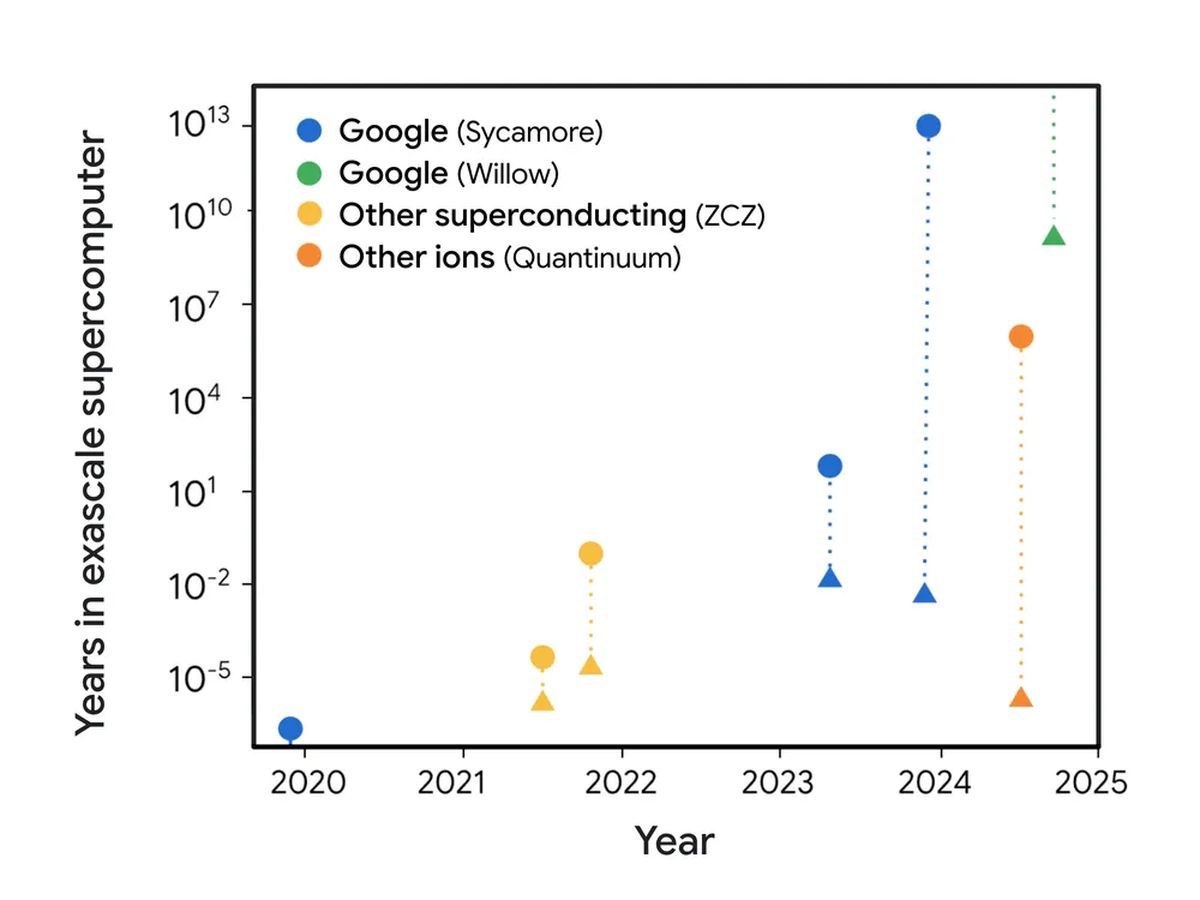
Can Google’s quantum chip prove you’re living in a multiverse
(Image: Google)

While Willow’s capabilities are impressive, some experts caution against drawing conclusions about the multiverse. Astrophysicist Ethan Siegel argued that the success of quantum computers does not necessarily validate the existence of parallel dimensions, stating, “You can have quantum mechanics work just fine…without introducing even one parallel universe.” This perspective highlights ongoing debates within the scientific community regarding the implications of quantum computing breakthroughs.

In response to Google’s announcement, concerns were raised about the nature of the computation that Willow completed. German physicist Sabine Hossenfelder pointed out that the specific problem solved by the chip—producing a random distribution—has no practical application. She indicated that while Google might claim their computation is astonishing, the actual task has been framed in a way to emphasize its difficulty for classical computers.

Additionally, Hossenfelder commented that Google’s approach appears similar to a previous achievement where a lower number of qubits (about 50) was used to make similar claims. The current challenge, according to Hossenfelder, remains that practical applications of quantum computing may require approximately one million qubits—vastly beyond the capabilities of the Willow chip, which features 100 qubits.

This skepticism reflects a broader pattern observed following Google’s announcement of “quantum supremacy” in 2019, which ignited a dispute with rival IBM. IBM researchers contended that Google had overstated its claims and asserted that the computations in question could be performed on classical systems within a reasonable timeframe. This rivalry has fueled continued scrutiny of Google’s assertions regarding office capabilities in quantum computing and their significance.


Featured image credit: Morgan Housel/Unsplash

Tags: Featuredquantum computing

Related Posts

“Free robots are an illusion”: Why we’ll pay for system intelligence, not delivery workers

“Free robots are an illusion”: Why we’ll pay for system intelligence, not delivery workers

June 12, 2026
How Henrique Schmaiske led Meteor.js through its biggest transformation

How Henrique Schmaiske led Meteor.js through its biggest transformation

June 12, 2026
Proven privacy: Why ‘no-log’ claims need real evidence today

Proven privacy: Why ‘no-log’ claims need real evidence today

June 12, 2026
ChatGPT hits 1 billion users as global AI adoption surges despite backlash

ChatGPT hits 1 billion users as global AI adoption surges despite backlash

June 12, 2026
Huawei launches HarmonyOS 7 developer beta with upgraded API 26

Huawei launches HarmonyOS 7 developer beta with upgraded API 26

June 12, 2026
OpenAI Codex referral program rewards users with extra rate resets

OpenAI Codex referral program rewards users with extra rate resets

June 12, 2026

LATEST NEWS

“Free robots are an illusion”: Why we’ll pay for system intelligence, not delivery workers

How Henrique Schmaiske led Meteor.js through its biggest transformation

Proven privacy: Why ‘no-log’ claims need real evidence today

ChatGPT hits 1 billion users as global AI adoption surges despite backlash

Huawei launches HarmonyOS 7 developer beta with upgraded API 26

OpenAI Codex referral program rewards users with extra rate resets

BEST AI MODELS LEADERBOARD

See the best AI models, ranked by intelligence, benchmark results, speed and token price. Find the most suitable LLMs, Text-to-Image, Image Editing, Text-to-Speech, Text-to-Video and Image-to-Video  artificial intelligence model for your tasks and business.

LATEST TOOLS

Roboto AI

Pickaxe

Pfpmaker

MindPal

Syllaby

ScreenApp

FinanceBrain

GitHub Spark

Hints

VisionStory AI

Dataconomy

COPYRIGHT © DATACONOMY MEDIA GMBH, ALL RIGHTS RESERVED.

  • About
  • Imprint
  • Contact
  • Legal & Privacy

Follow Us

  • News
    • Artificial Intelligence
    • Cybersecurity
    • DeFi & Blockchain
    • Finance
    • Gaming
    • Startups
    • Tech
  • Industry
  • Research
  • Resources
    • Articles
    • Guides
    • Case Studies
    • Whitepapers
    • AI Models Leaderboard
  • AI tools
  • Newsletter
  • + More
    • Glossary
    • Conversations
    • Events
    • About
      • Who we are
      • Contact
      • Imprint
      • Legal & Privacy
      • Partner With Us
No Result
View All Result
Subscribe

This website uses cookies to improve your experience. You can choose to accept or reject them. Visit our Privacy Policy.