Dataconomy
  • News
    • Artificial Intelligence
    • Cybersecurity
    • DeFi & Blockchain
    • Finance
    • Gaming
    • Startups
    • Tech
  • Industry
  • Research
  • Resources
    • Articles
    • Guides
    • Case Studies
    • Whitepapers
    • AI Models Leaderboard
  • AI toolsNEW
  • Newsletter
  • + More
    • Glossary
    • Conversations
    • Events
    • About
      • Who we are
      • Contact
      • Imprint
      • Legal & Privacy
      • Partner With Us
Subscribe
No Result
View All Result
  • AI
  • Tech
  • Cybersecurity
  • Finance
  • DeFi & Blockchain
  • Startups
  • Gaming
Dataconomy
  • News
    • Artificial Intelligence
    • Cybersecurity
    • DeFi & Blockchain
    • Finance
    • Gaming
    • Startups
    • Tech
  • Industry
  • Research
  • Resources
    • Articles
    • Guides
    • Case Studies
    • Whitepapers
    • AI Models Leaderboard
  • AI toolsNEW
  • Newsletter
  • + More
    • Glossary
    • Conversations
    • Events
    • About
      • Who we are
      • Contact
      • Imprint
      • Legal & Privacy
      • Partner With Us
Subscribe
No Result
View All Result
Dataconomy
No Result
View All Result

Meet Microsoft Magentic-One: A generalist multi-agent AI system

Magentic-One is a generalist multi-agent system that uses an orchestrator to coordinate different agents, each specializing in a particular task.

byKerem Gülen
November 7, 2024
in Artificial Intelligence, News
Home News Artificial Intelligence
Share on FacebookShare on TwitterShare on LinkedInShare on WhatsAppShare on e-mail
Google Preferred Source

Microsoft has introduced a new multi-agent artificial intelligence (AI) system called Magentic-One, designed to complete complex tasks using multiple specialized agents. Available as an open-source tool on Microsoft AutoGen, this system aims to assist developers and researchers in creating applications that can autonomously manage multi-step tasks across various domains.

What is Magentic-One?

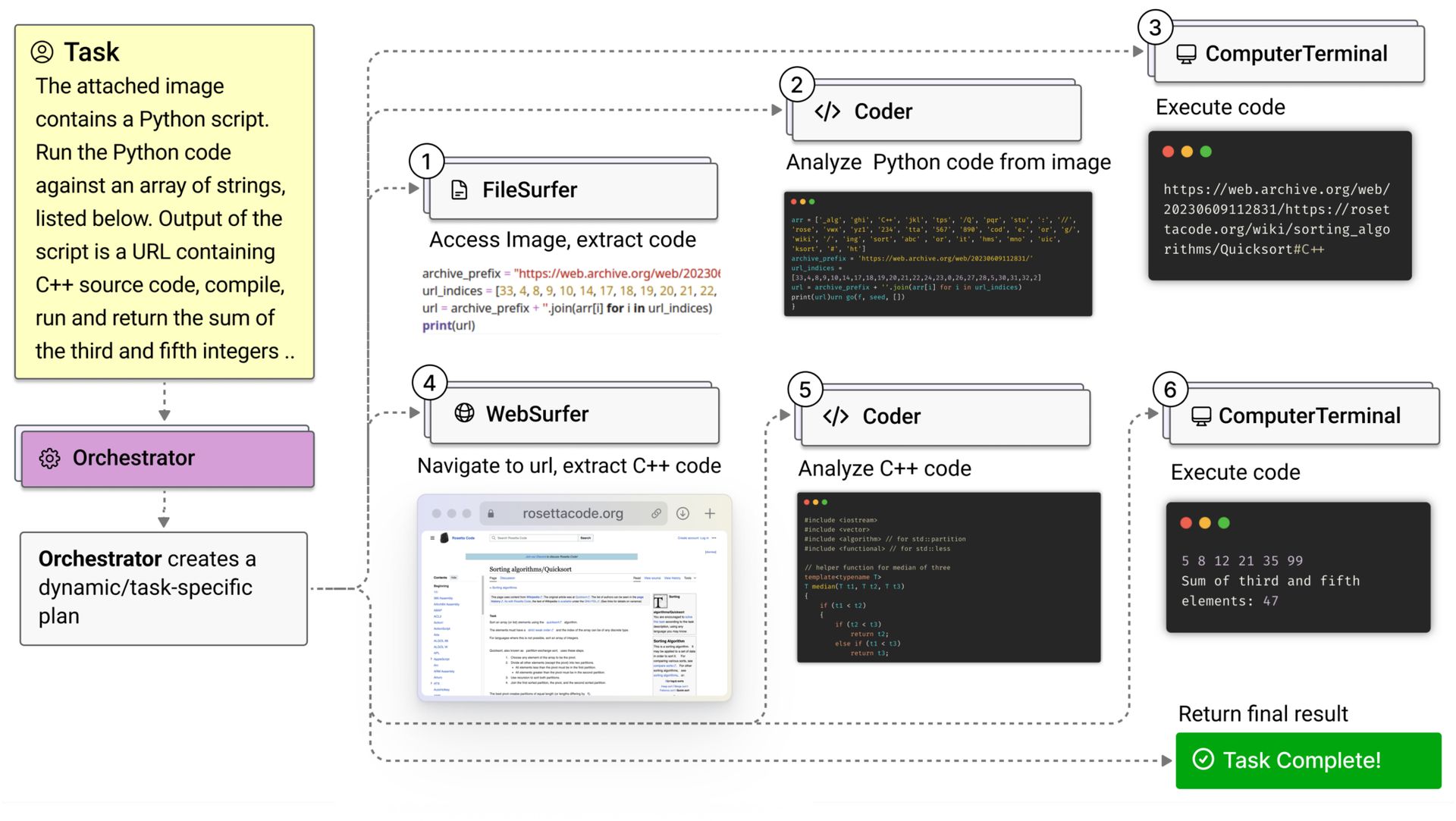
Magentic-One is a generalist multi-agent system that uses an orchestrator to coordinate different agents, each specializing in a particular task. The lead agent, called the Orchestrator, works alongside four specialized agents:

  • WebSurfer agent: Handles web browsing, clicks, and web content summarization.
  • FileSurfer agent: Manages local files, directories, and folders.
  • Coder agent: Writes and executes code, analyzes information, and creates new projects.
  • ComputerTerminal agent: Provides a console for program execution by the Coder Agent.

These agents work together to solve open-ended tasks, making Magentic-One suitable for applications like software engineering, data analysis, and scientific research. Microsoft describes Magentic-One as a “flexible and scalable alternative to single-agent systems” due to its modular design, which allows agents to be added or removed without affecting the system’s core structure.
Stay Ahead of the Curve!

Don't miss out on the latest insights, trends, and analysis in the world of data, technology, and startups. Subscribe to our newsletter and get exclusive content delivered straight to your inbox.

Meet Microsoft Magnetic-One: A generalist multi-agent AI system
These agents work together to solve open-ended tasks, making Magentic-One suitable for applications (Image: Microsoft)

Key features

Magentic-One stands out because of its ability to activate multiple agents using a single language model. The system can perform various tasks, from navigating web browsers to executing Python code. This functionality means it can handle real-world scenarios such as booking tickets, purchasing products, or editing documents on a local device.

The modular multi-agent architecture ensures that each agent has a distinct responsibility, resulting in higher efficiency for complex, multi-step tasks. This approach enables Magentic-One to divide a problem into subtasks, improving both accuracy and speed of task completion. For example, if the system is asked to book a movie ticket, each agent will handle a different part of the task, such as processing visual information, navigating the website, and completing the transaction.

Microsoft’s AutoGen framework powers Magentic-One, supporting integration with various large and small language models to meet different cost and performance requirements. Currently, the system is tested with models like GPT-4o and OpenAI’s o1-preview, though it remains model-agnostic, allowing for future flexibility.

To assess the effectiveness of Magentic-One, Microsoft has also released AutoGenBench, a tool that evaluates agentic performance on several benchmarks such as GAIA, AssistantBench, and WebArena. These benchmarks focus on tasks like multi-step planning and tool usage. Microsoft’s initial tests from October 2024 indicate that Magentic-One delivers competitive results against state-of-the-art methods.

https://www.microsoft.com/en-us/research/uploads/prod/2024/11/citations_m1.mp4

Video: Microsoft

The growing trend: Multi-agent systems

Magentic-One is part of a growing trend towards multi-agent AI systems. OpenAI has introduced Swarm, another framework aimed at building and deploying multi-agent systems. Similarly, IBM launched the Bee Agent Framework, an open-source toolkit that supports deploying agent-based workflows, compatible with models like IBM Granite and Llama 3.2. These systems, much like Magentic-One, aim to offer scalable solutions to complex problem-solving tasks.

According to Microsoft, “Magentic-One’s plug-and-play design supports easy adaptation and extensibility by enabling agents to be added or removed without altering other agents or the overall architecture.” This flexibility is particularly important for evolving business needs and new applications, making Magentic-One a promising tool for researchers and developers seeking to create more adaptive AI systems.


Featured image credit: Kerem Gülen/Ideogram

Tags: FeaturedMicrosoft

Related Posts

Apple touchscreen MacBook could launch with M5 Pro chips

Apple touchscreen MacBook could launch with M5 Pro chips

June 29, 2026
Apple touchscreen MacBook could launch with M5 Pro chips

Apple touchscreen MacBook could launch with M5 Pro chips

June 29, 2026
OpenAI limits ChatGPT 5.6 access to government-approved users first

OpenAI limits ChatGPT 5.6 access to government-approved users first

June 26, 2026
Apple to skip M6 Pro and Max chips and launch M7 in 2027

Apple to skip M6 Pro and Max chips and launch M7 in 2027

June 26, 2026
IBM unveils world’s first sub-1nm chip with new nanostack architecture

IBM unveils world’s first sub-1nm chip with new nanostack architecture

June 26, 2026
Apple raises prices across Macs, iPads and home devices

Apple raises prices across Macs, iPads and home devices

June 26, 2026

LATEST NEWS

Apple touchscreen MacBook could launch with M5 Pro chips

Apple touchscreen MacBook could launch with M5 Pro chips

OpenAI limits ChatGPT 5.6 access to government-approved users first

Apple to skip M6 Pro and Max chips and launch M7 in 2027

IBM unveils world’s first sub-1nm chip with new nanostack architecture

Apple raises prices across Macs, iPads and home devices

BEST AI MODELS LEADERBOARD

See the best AI models, ranked by intelligence, benchmark results, speed and token price. Find the most suitable LLMs, Text-to-Image, Image Editing, Text-to-Speech, Text-to-Video and Image-to-Video  artificial intelligence model for your tasks and business.

LATEST TOOLS

Autoppt

Otter.ai

Slideoo

Disney Pixar AI Generator

Codebay

Newo

BlackInk.AI

WatchMyCompetitor

TokkingHeads

Fellow.app

Dataconomy

COPYRIGHT © DATACONOMY MEDIA GMBH, ALL RIGHTS RESERVED.

  • About
  • Imprint
  • Contact
  • Legal & Privacy

Follow Us

  • News
    • Artificial Intelligence
    • Cybersecurity
    • DeFi & Blockchain
    • Finance
    • Gaming
    • Startups
    • Tech
  • Industry
  • Research
  • Resources
    • Articles
    • Guides
    • Case Studies
    • Whitepapers
    • AI Models Leaderboard
  • AI tools
  • Newsletter
  • + More
    • Glossary
    • Conversations
    • Events
    • About
      • Who we are
      • Contact
      • Imprint
      • Legal & Privacy
      • Partner With Us
No Result
View All Result
Subscribe

This website uses cookies to improve your experience. You can choose to accept or reject them. Visit our Privacy Policy.