Is machine learning AI? It is a common question for those navigating the complexities of modern technology and seeking to understand how these transformative fields are reshaping industries and everyday life. Although both terms are often used interchangeably, they represent distinct yet interconnected facets of computer science and artificial intelligence.
Understanding the relationship between machine learning and AI is crucial for grasping their combined potential to drive innovation and solve complex problems in the digital age.
Is machine learning AI?
Yes, machine learning is a subset of artificial intelligence (AI). Artificial intelligence is a broader field that encompasses any system or machine that exhibits human-like intelligence, such as reasoning, learning, and problem-solving. Machine learning specifically focuses on algorithms and statistical models that allow computers to learn from and make decisions or predictions based on data without being explicitly programmed for each task.
Unlike traditional programming, where rules are explicitly coded, machine learning algorithms allow systems to learn from patterns and experiences without human intervention. Artificial intelligence, on the other hand, is a broader concept that encompasses machines or systems capable of performing tasks that typically require human intelligence. This includes understanding natural language, recognizing patterns, solving problems, and learning from experience.
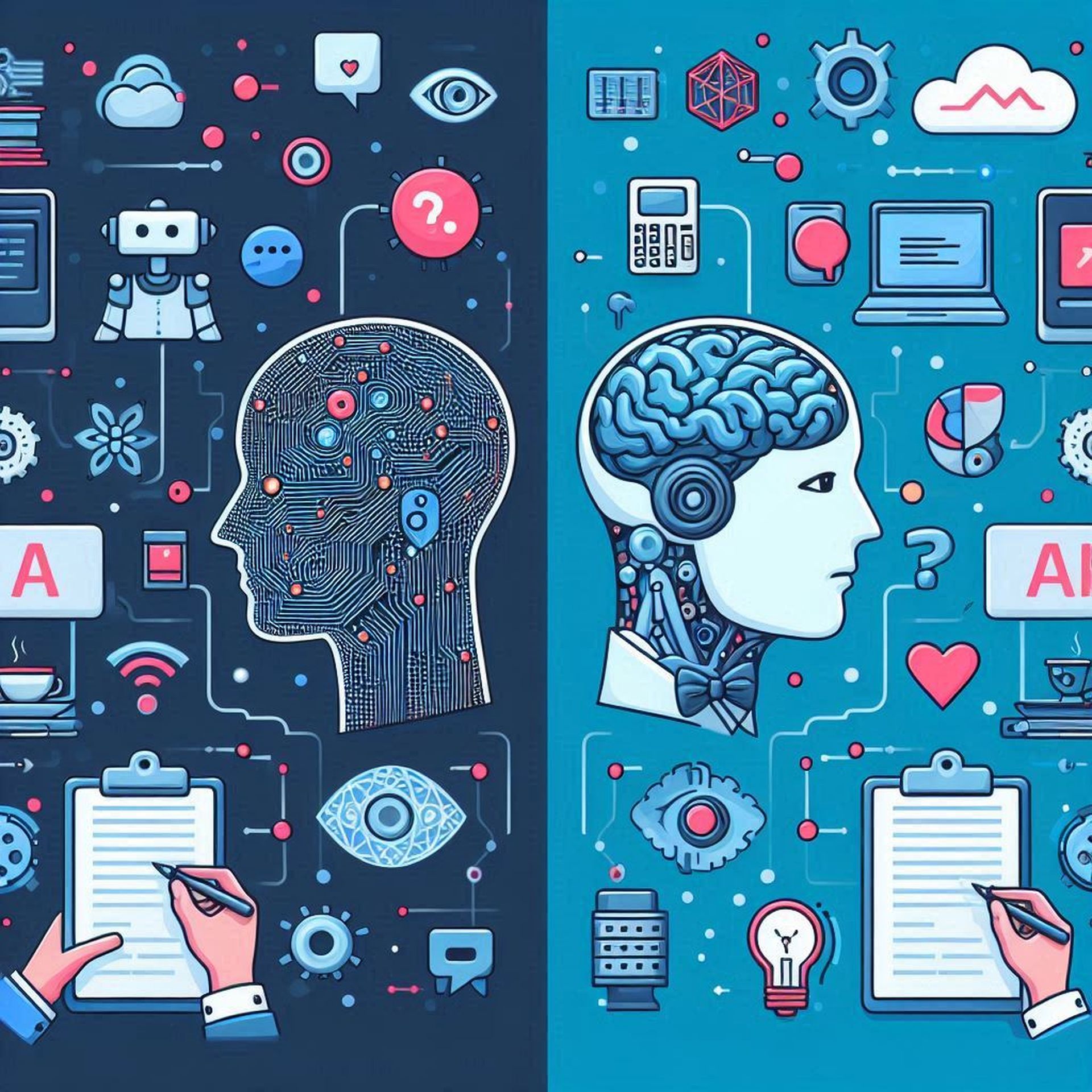
In essence, machine learning is one of the techniques used to achieve AI’s goals by enabling systems to learn and improve from experience automatically. Are you confused? Let’s look closely at them and understand their similarities and differences.
AI vs ML: What are the differences?
Here is a cheat sheet for differences between AI and ML:
| Aspect | Machine Learning (ML) | Artificial Intelligence (AI) |
| Function | Learns from data to make predictions or decisions. |
Mimics human cognitive functions like reasoning, learning, problem-solving, perception, and language understanding.
|
| Scope | Narrow, focuses on specific tasks with data-driven approach. |
Broad, encompasses various technologies and approaches including machine learning, expert systems, neural networks, and more.
|
| Applications | Natural Language Processing (NLP), image/speech recognition, recommendation systems, predictive analytics, autonomous systems (e.g., self-driving cars). |
Healthcare (medical diagnosis, personalized medicine), finance (algorithmic trading, fraud detection), robotics (industrial automation, autonomous agents), gaming, virtual assistants (chatbots, voice assistants).
|
| Approach | Relies on statistical techniques (supervised, unsupervised, reinforcement learning) to analyze and interpret patterns in data. |
Utilizes machine learning techniques as well as rule-based systems, expert systems, genetic algorithms, and more to simulate human-like intelligence and behavior.
|
| Examples | Netflix recommendations, Siri, Google Translate, self-driving cars. |
IBM Watson, DeepMind’s AlphaGo, Amazon Alexa, autonomous robots in manufacturing.
|
| Learning capability | Learns and improves performance from experience and data. |
Capable of continuous learning and adaptation to new data and scenarios, often with feedback loops for improvement.
|
| Flexibility | Adapts to new data and changes in the environment over time. |
Can adapt to diverse tasks and environments, potentially integrating multiple AI techniques for complex tasks.
|
| Autonomy | Can autonomously make decisions based on learned patterns. |
Aims for high autonomy in decision-making and problem-solving, capable of complex reasoning and adaptation.
|
| Complexity of tasks | Handles specific tasks with defined objectives and data inputs. |
Tackles complex tasks requiring human-like cognitive abilities such as reasoning, understanding context, and making nuanced decisions.
|
| Human interaction | Often enhances user experience through personalized recommendations and interactions. |
Facilitates direct interaction with users through natural language understanding and responses, enhancing usability and accessibility.
|
| Ethical considerations | Raises ethical questions around data privacy, bias in algorithms, and transparency in decision-making. |
Involves complex ethical considerations related to AI ethics, including fairness, accountability, and the societal impact of intelligent systems.
|
| Future trends | Advances driven by big data, improved algorithms, and hardware capabilities. |
Continues to evolve with advancements in neural networks, reinforcement learning, explainable AI, and AI ethics.
|
Machine learning (ML) and artificial intelligence (AI) are interconnected fields with distinct roles and capabilities. ML, a subset of AI, focuses on algorithms that learn from data to make predictions or decisions, enhancing tasks like recommendation systems and autonomous driving. AI, on the other hand, encompasses ML along with broader technologies to simulate human-like intelligence, tackling complex tasks such as medical diagnosis and natural language processing.
While ML excels in data-driven learning and adaptability, AI extends to include sophisticated reasoning, autonomy in decision-making, and direct human interaction through applications like virtual assistants and autonomous agents. Both fields face ethical challenges regarding data privacy, algorithmic bias, and societal impact, while future trends indicate continual evolution in AI’s capabilities through advancements in neural networks, explainable AI, and ethical frameworks, shaping their transformative impact across industries and everyday life.
Is machine learning AI? Now, you know the answer and all the differences between AI and ML!
All images are generated by Eray Eliaçık/Bing