Dataconomy
  • News
    • Artificial Intelligence
    • Cybersecurity
    • DeFi & Blockchain
    • Finance
    • Gaming
    • Startups
    • Tech
  • Industry
  • Research
  • Resources
    • Articles
    • Guides
    • Case Studies
    • Whitepapers
    • AI Models Leaderboard
  • AI toolsNEW
  • Newsletter
  • + More
    • Glossary
    • Conversations
    • Events
    • About
      • Who we are
      • Contact
      • Imprint
      • Legal & Privacy
      • Partner With Us
Subscribe
No Result
View All Result
  • AI
  • Tech
  • Cybersecurity
  • Finance
  • DeFi & Blockchain
  • Startups
  • Gaming
Dataconomy
  • News
    • Artificial Intelligence
    • Cybersecurity
    • DeFi & Blockchain
    • Finance
    • Gaming
    • Startups
    • Tech
  • Industry
  • Research
  • Resources
    • Articles
    • Guides
    • Case Studies
    • Whitepapers
    • AI Models Leaderboard
  • AI toolsNEW
  • Newsletter
  • + More
    • Glossary
    • Conversations
    • Events
    • About
      • Who we are
      • Contact
      • Imprint
      • Legal & Privacy
      • Partner With Us
Subscribe
No Result
View All Result
Dataconomy
No Result
View All Result

This Model Can Predict 7 out 10 Supreme Court Rulings

byEileen McNulty
August 5, 2014
in Artificial Intelligence, News
Home News Artificial Intelligence
Share on FacebookShare on TwitterShare on LinkedInShare on WhatsAppShare on e-mail
Google Preferred Source

It is widely believed that predicting natural elements- the spread of wildfire, or disease, for example- is entirely possible. Yet when it comes to modelling human behaviour, many like to think there’s a certain unique, unpredictable character to humanity that cannot be pinned down by algorithms. Yet three scholars- South Texas College of Law’s Josh Blackman, Michigan State’s Daniel Martin Katz, and Bommarito Consulting’s Michael Bommarito- have built a predictive model which can determine how US Supreme Court judges will vote, with nearly 70% accuracy.

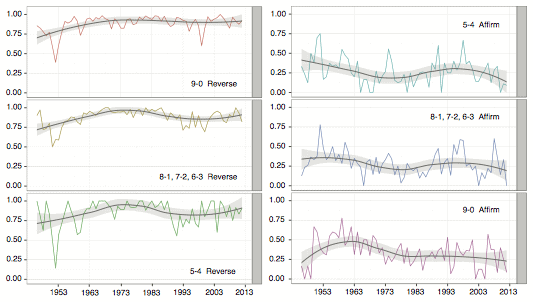
In a blog post announcing the model, Blackman states the model “correctly identifies 69.7% of the Supreme Court’s overall affirm and reverse decisions and correctly forecasts 70.9% of the votes of individual justices across 7,700 cases and more than 68,000 justice votes.” There have been similarly accurate models before, but not over such a broad span of time. This model predicts the outcomes of cases from 1953 to present, across 7,700 cases and in excess of 68,000 individual justice votes, spanning the Roberts, Rehnquist, Burger and Warren courts.

The model itself is incredibly complex. It was created using data from the Washington University at St. Louis’s Supreme Court Database, plus their own additional variable. It uses 95 variables with 4- or 5-place decimal weighting. Each justice’s vote is determined by 4,000 extremely randomised decision trees. To put it simply, Bonmarito asks, “Have you seen some of those memes that go around where there’s a big flow chart where you’re supposed to answer ‘Yes,’ or ‘No,’ to a bunch of questions and there’s a sassy response at the bottom?” The decision trees resemble these, albeit with more mathematical accuracy and less sassy responses.
Stay Ahead of the Curve!

Don't miss out on the latest insights, trends, and analysis in the world of data, technology, and startups. Subscribe to our newsletter and get exclusive content delivered straight to your inbox.

us supreme court

One of the more interesting findings is evidence that Supreme Court justices are not above politics. “If there were an argument ongoing between political scientists and lawyers as to what mattered, as to whether judges are really independent judicial reasoning machines on high, or whether they’re just political animals like anyone else, then in terms of the features that the model uses to successfully predict, it appears they’re just political animals,” Bonmarito remarks. Alot of the Supreme Court decisions are 9-0 reversals of decisions from the lower courts. But in the one in three cases where the court affirms the lower court’s ruling, ideological lines are drawn and the model gets alot less accurate.

Moving forward, the team are looking at extending the predictive model to predict lower court decisions. There isn’t a strong database from outcomes of district and appellate court cases. Such a model could prove extremely valuable for lawyers plotting their courtroom negotiation strategies.

Read more here.
(Image credit: Mark Fischer)

Follow @DataconomyMedia

Interested in more content like this? Sign up to our newsletter, and you wont miss a thing!

[mc4wp_form]

Related Posts

Why Telegram Mini Apps have become the optimal ecosystem for launching AI SaaS products

Why Telegram Mini Apps have become the optimal ecosystem for launching AI SaaS products

June 3, 2026
Crypto investors are watching one date closely in 2026

Crypto investors are watching one date closely in 2026

June 3, 2026
How Telegram Creators test post visibility before running growth campaigns

How Telegram Creators test post visibility before running growth campaigns

June 3, 2026
Does your AI clock in without you?

Does your AI clock in without you?

June 3, 2026
Why secure software delivery depends on better release management

Why secure software delivery depends on better release management

June 3, 2026
Sony reveals God of War: Laufey for PS5

Sony reveals God of War: Laufey for PS5

June 3, 2026
Please login to join discussion

LATEST NEWS

Why Telegram Mini Apps have become the optimal ecosystem for launching AI SaaS products

Crypto investors are watching one date closely in 2026

How Telegram Creators test post visibility before running growth campaigns

Does your AI clock in without you?

Why secure software delivery depends on better release management

Sony reveals God of War: Laufey for PS5

BEST AI MODELS LEADERBOARD

See the best AI models, ranked by intelligence, benchmark results, speed and token price. Find the most suitable LLMs, Text-to-Image, Image Editing, Text-to-Speech, Text-to-Video and Image-to-Video  artificial intelligence model for your tasks and business.

LATEST TOOLS

Veed.io

Paper Pilot

IsOn24

Magnific

DADABOTS

Rosebud AI

Prome

Pageon AI

Vyond

Centauri AI

Dataconomy

COPYRIGHT © DATACONOMY MEDIA GMBH, ALL RIGHTS RESERVED.

  • About
  • Imprint
  • Contact
  • Legal & Privacy

Follow Us

  • News
    • Artificial Intelligence
    • Cybersecurity
    • DeFi & Blockchain
    • Finance
    • Gaming
    • Startups
    • Tech
  • Industry
  • Research
  • Resources
    • Articles
    • Guides
    • Case Studies
    • Whitepapers
    • AI Models Leaderboard
  • AI tools
  • Newsletter
  • + More
    • Glossary
    • Conversations
    • Events
    • About
      • Who we are
      • Contact
      • Imprint
      • Legal & Privacy
      • Partner With Us
No Result
View All Result
Subscribe

This website uses cookies to improve your experience. You can choose to accept or reject them. Visit our Privacy Policy.