IP Adapter FaceID
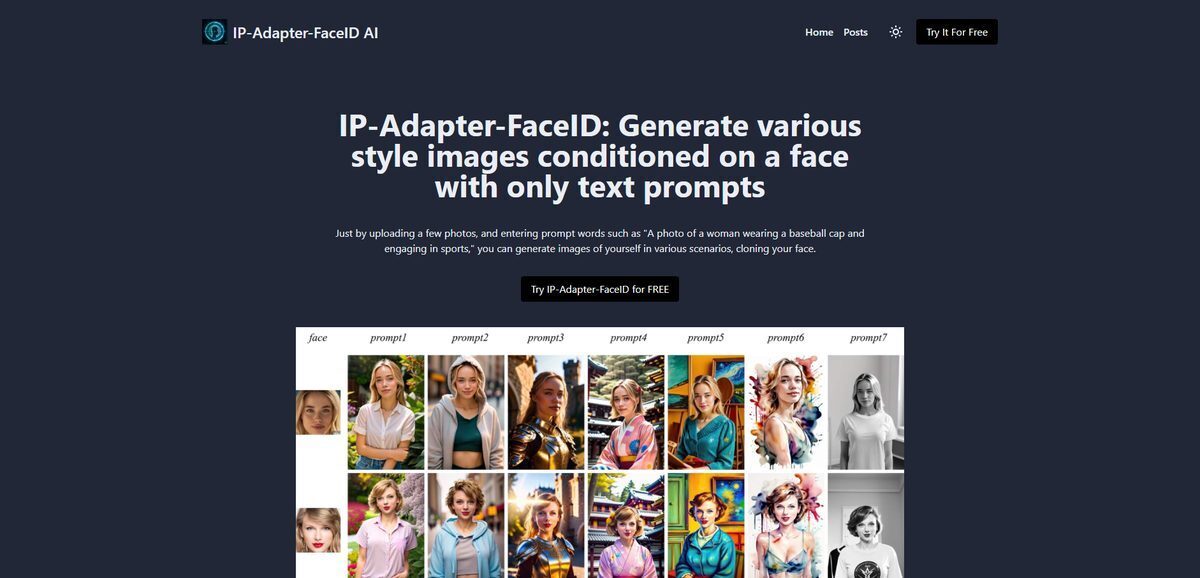
IP-Adapter-FaceID is a web-based AI tool that allows users to generate stylistically diverse images conditioned on a reference facial photo using only text prompts, such as placing the face in various scenarios like sports or different roles. It leverages face ID embeddings for superior consistency, combines IP-Adapter with LoRA, and supports advanced features like adjustable face weights, image-to-image, inpainting, and compatibility with Stable Diffusion, ControlNet, ComfyUI, and SDXL models. Ideal for content creators, it enables custom image creation across styles and contexts while transparently discussing limitations, biases, and future improvements. The core version is widely accessible and free to try, with cross-platform support on Linux, Windows, and more.
Pros
- Generates stylistically different images from facial photo
- High face consistency and ID fidelity
- Supports diverse text prompts for scenarios and roles
- User-friendly web interface
- Compatible with Stable Diffusion and ComfyUI
- Adjustable face structure weight for customization
- Free trial available with experimental SDXL version
Cons
- Requires uploading facial images
- Limited primarily to facial image inputs
- Heavily dependent on quality of text prompts
- No mobile application available
- GPU resources may be scarce and fail
- Potential biases and limitations disclosed
- No batch processing mentioned
- Experimental versions may have reliability issues
The main purpose of IP-Adapter-FaceID AI is to allow users to generate a variety of stylistically different images based on a facial image and accompanying textual prompts.
IP-Adapter-FaceID AI works by users first uploading a facial photo, they then fill in text prompts such as 'A photo of a woman wearing a baseball cap and engaging in sports.' The AI then generates customised images reflecting these descriptions.
The unique features of IP-Adapter-FaceID AI include the generation of various styles of images based on a facial image and text prompts, its transparency on limitations and biases, and its comprehensive guide about its methodology.
Yes, IP-Adapter-FaceID can be tried for free. The option to 'Try it for free' is directly available on their homepage.
The usefulness of generating varied images of the same face with IP-Adapter-FaceID lies in its ability to produce diverse image iterations of the same face in different contexts or roles, enabling personalization and bringing an element of creativity to image generation.
The limitations of IP-Adapter-FaceID AI can be found in their transparent discussions on their website, under the 'Limitations and Bias of IP-Adapter-FaceID' post.
The guide on the methodology of IP-Adapter-FaceID AI can be found on their website in the post titled 'Methodology behind IP-Adapter-FaceID'.
You can use IP-Adapter-FaceID to clone your face in different scenarios by uploading your facial photo and entering appropriate prompts that describe the scenario you wish to see your face in.
The uniqueness in image generation experience with IP-Adapter-FaceID comes from its ability to generate customised images based on a facial image and text prompts, giving users the power to creative diverse image renditions.
Yes, IP-Adapter-FaceID is compatible with Stable Diffusion (SD 1.5 and SDXL), ComfyUI, ControlNet, and T2I-Adapter for enhanced structure control and multimodal generation.
Become a Contributor
Sign in to unlock these features:
- ⭐️ Rate this tool with a 1-5 star score
- ✍️ Write a detailed review for the community
- ❤️ Follow this tool to get important updates
Get started in seconds
[jnews_social_login_form]