Dataconomy
  • News
    • Artificial Intelligence
    • Cybersecurity
    • DeFi & Blockchain
    • Finance
    • Gaming
    • Startups
    • Tech
  • Industry
  • Research
  • Resources
    • Articles
    • Guides
    • Case Studies
    • Whitepapers
    • AI Models Leaderboard
  • AI toolsNEW
  • Newsletter
  • + More
    • Glossary
    • Conversations
    • Events
    • About
      • Who we are
      • Contact
      • Imprint
      • Legal & Privacy
      • Partner With Us
Subscribe
No Result
View All Result
  • AI
  • Tech
  • Cybersecurity
  • Finance
  • DeFi & Blockchain
  • Startups
  • Gaming
Dataconomy
  • News
    • Artificial Intelligence
    • Cybersecurity
    • DeFi & Blockchain
    • Finance
    • Gaming
    • Startups
    • Tech
  • Industry
  • Research
  • Resources
    • Articles
    • Guides
    • Case Studies
    • Whitepapers
    • AI Models Leaderboard
  • AI toolsNEW
  • Newsletter
  • + More
    • Glossary
    • Conversations
    • Events
    • About
      • Who we are
      • Contact
      • Imprint
      • Legal & Privacy
      • Partner With Us
Subscribe
No Result
View All Result
Dataconomy
No Result
View All Result

A wireless eye implant helps patients with severe macular degeneration read again

In the one year study 27 of 32 participants regained the ability to read with prosthetic central vision.

byAytun Çelebi
November 18, 2025
in Research
Home Research
Share on FacebookShare on TwitterShare on LinkedInShare on WhatsAppShare on e-mail
Google Preferred Source

A Stanford Medicine-developed wireless eye implant restores reading ability in individuals with advanced macular degeneration by using infrared light and smart glasses to replace lost photoreceptors.

A wireless chip, coupled with smart glasses, has partially restored vision for individuals with advanced age-related macular degeneration. A clinical study involving Stanford Medicine and international collaborators saw 27 of 32 participants regain reading ability within one year of implantation. These results, detailed on October 20 in the New England Journal of Medicine, showed that digital enhancements allowed some participants to achieve visual sharpness comparable to 20/42 vision.

The PRIMA implant, developed at Stanford Medicine, marks the first prosthetic eye device to restore usable vision, enabling patients to recognize shapes and patterns, known as form vision. Daniel Palanker, PhD, professor of ophthalmology and a co-senior author, stated, “We are the first to provide form vision.” José-Alain Sahel, MD, from the University of Pittsburgh School of Medicine, co-led research with Frank Holz, MD, from the University of Bonn, as lead author.

Stay Ahead of the Curve!

Don't miss out on the latest insights, trends, and analysis in the world of data, technology, and startups. Subscribe to our newsletter and get exclusive content delivered straight to your inbox.

The PRIMA system comprises a small camera on glasses and a retinal implant. The camera captures visual data, projecting it via infrared light to the implant, which then converts it into electrical signals. These signals substitute for damaged photoreceptors, forwarding visual information to the brain. Palanker conceived the idea two decades ago, noting, “The device we imagined in 2005 now works in patients remarkably well.”

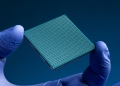
Participants in the trial had geographic atrophy, an advanced stage of age-related macular degeneration affecting over 5 million people worldwide. This condition destroys central vision through the deterioration of light-sensitive photoreceptor cells. The 2 by 2 millimeters implant, placed where photoreceptors are lost, detects infrared light from the glasses. Palanker explained, “The projection is done by infrared because we want to make sure it’s invisible to the remaining photoreceptors outside the implant.”

This design allows patients simultaneous use of natural peripheral vision and prosthetic central vision, enhancing orientation. Palanker emphasized, “The fact that they see simultaneously prosthetic and peripheral vision is important because they can merge and use vision to its fullest.” The implant is photovoltaic, operating wirelessly by relying on light for electrical current, allowing safe subretinal placement without external power sources or cables.

The trial included 38 patients over 60 with geographic atrophy and vision worse than 20/320 in at least one eye. Patients began using glasses four to five weeks post-implantation. Visual acuity improved over months of training; Palanker noted, “It may take several months of training to reach top performance.” Of the 32 patients completing the one-year trial, 27 could read, and 26 demonstrated clinically meaningful improvement, defined as reading at least two additional lines on a standard eye chart. Participants’ visual acuity improved by 5 lines on average, with one improving by 12 lines.

They used the prosthesis for daily tasks, reading books, food labels, and subway signs with adjustable contrast, brightness, and up to 12x magnification. Two-thirds reported medium to high user satisfaction. Nineteen participants experienced side effects, including ocular hypertension, peripheral retinal tears, and subretinal hemorrhage, most resolving within two months and none life-threatening.

Currently, the PRIMA device provides only black-and-white vision. Palanker is developing software for grayscale and higher-resolution chips for improved face recognition. Current chips have 100-micron pixels, with 378 pixels per chip. New versions, tested in rats, may feature 20-micron pixels and 10,000 pixels per chip, potentially offering 20/80 vision. Palanker also aims to test the device for other types of blindness from lost photoreceptors. “The next generation of the chip, with smaller pixels, will have better resolution and be paired with sleeker-looking glasses,” he stated.


Featured image credit

Tags: infrared lightSmart Glasseswireless eye implant

Related Posts

Faith in large employers is fading among UK workers

Faith in large employers is fading among UK workers

June 5, 2026
Army-funded scientists explore a new frontier in quantum physics

Army-funded scientists explore a new frontier in quantum physics

June 5, 2026
New MIT process could make lithium production cheaper and cleaner

New MIT process could make lithium production cheaper and cleaner

June 4, 2026
Researchers create AI worm that adapts attacks without human input

Researchers create AI worm that adapts attacks without human input

June 4, 2026
Researchers unlock 20-fold enhancement in ultrafast laser experiments

Researchers unlock 20-fold enhancement in ultrafast laser experiments

June 3, 2026
NASA tests next-gen radiation-hardened space computer chip

NASA tests next-gen radiation-hardened space computer chip

May 29, 2026

LATEST NEWS

“Free robots are an illusion”: Why we’ll pay for system intelligence, not delivery workers

How Henrique Schmaiske led Meteor.js through its biggest transformation

Proven privacy: Why ‘no-log’ claims need real evidence today

ChatGPT hits 1 billion users as global AI adoption surges despite backlash

Huawei launches HarmonyOS 7 developer beta with upgraded API 26

OpenAI Codex referral program rewards users with extra rate resets

BEST AI MODELS LEADERBOARD

See the best AI models, ranked by intelligence, benchmark results, speed and token price. Find the most suitable LLMs, Text-to-Image, Image Editing, Text-to-Speech, Text-to-Video and Image-to-Video  artificial intelligence model for your tasks and business.

LATEST TOOLS

Roboto AI

Pickaxe

Pfpmaker

MindPal

Syllaby

ScreenApp

FinanceBrain

GitHub Spark

Hints

VisionStory AI

Dataconomy

COPYRIGHT © DATACONOMY MEDIA GMBH, ALL RIGHTS RESERVED.

  • About
  • Imprint
  • Contact
  • Legal & Privacy

Follow Us

  • News
    • Artificial Intelligence
    • Cybersecurity
    • DeFi & Blockchain
    • Finance
    • Gaming
    • Startups
    • Tech
  • Industry
  • Research
  • Resources
    • Articles
    • Guides
    • Case Studies
    • Whitepapers
    • AI Models Leaderboard
  • AI tools
  • Newsletter
  • + More
    • Glossary
    • Conversations
    • Events
    • About
      • Who we are
      • Contact
      • Imprint
      • Legal & Privacy
      • Partner With Us
No Result
View All Result
Subscribe

This website uses cookies to improve your experience. You can choose to accept or reject them. Visit our Privacy Policy.