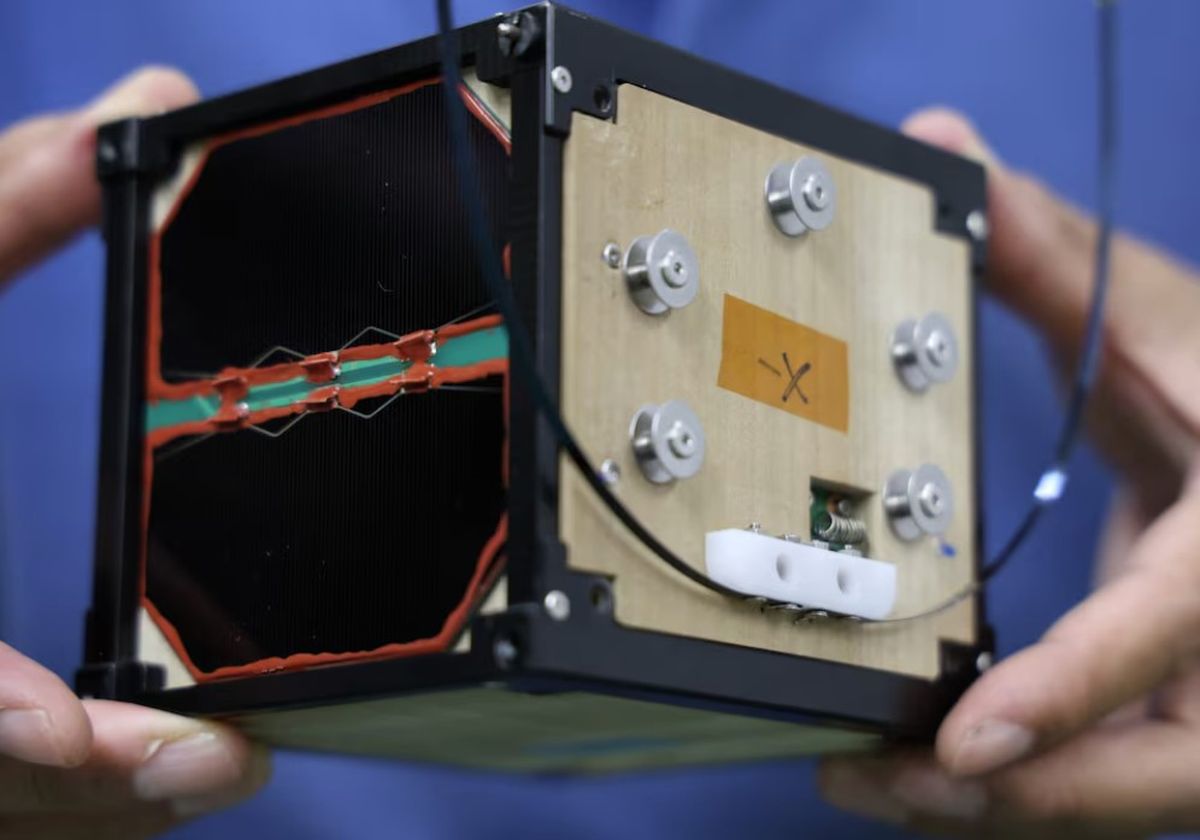
Japan has launched the world’s first wooden satellite, known as LignoSat, into space, Reuters reports. Created by researchers at Kyoto University in collaboration with Sumitomo Forestry, this small cube-shaped satellite was deployed aboard a SpaceX Falcon 9 rocket from NASA’s Kennedy Space Center. LignoSat is now on its way to the International Space Station (ISS), where it will soon be released into orbit to test the resilience of wood in space.
What is LignoSat: The world’s first wooden satellite
LignoSat, a 10 cm cube weighing just a few kilograms, is designed with honoki wood, a type of magnolia native to Japan. The satellite’s construction uses traditional Japanese craftsmanship without any screws or glue, enhancing its eco-friendly appeal. But LignoSat isn’t just about aesthetics or cultural heritage; it serves as a pilot project to test if wood can survive the extreme environment of space and offer a sustainable alternative to conventional satellite materials.
The name LignoSat derives from the Latin word “lignum,” meaning wood, signaling its creators’ intention to redefine how space structures are designed and built. Takao Doi, a former astronaut and professor at Kyoto University who spearheads the project, explained, “Satellites that are not made of metal should become mainstream,” as he believes wood’s unique properties may prove advantageous for space applications.
Why use wood for satellites?
Wood may not seem like an obvious choice for space technology, but it offers distinct benefits. Here’s why scientists and engineers are exploring its potential:
- Environmentally friendly: Traditional satellites are made from metals that do not fully disintegrate during re-entry, creating harmful metal particles in the atmosphere. Wood, however, burns up cleanly without leaving debris, making it a potential solution for reducing space pollution.
- Durability in space: Surprisingly, wood may perform better in space than on Earth. According to Kyoto University professor Koji Murata, “Wood is more durable in space because there’s no water or oxygen to rot or inflame it.” This resilience makes wood an attractive candidate for long-term space structures.
- Sustainability: Unlike metals, wood is a renewable resource that can be produced sustainably. As humanity looks toward lunar and Mars habitats, using self-replenishing materials like wood could support the creation of eco-friendly space infrastructures.
- Historical precedent: The idea of using wood in aerospace isn’t entirely new. As Professor Murata pointed out, “Early 1900s airplanes were made of wood.” Given that wooden structures have previously proven their resilience, researchers are optimistic that LignoSat will validate wood’s potential as a space-grade material.
How will LignoSat test the properties of wood in space?
Once released from the ISS, LignoSat will remain in orbit for around six months, during which its durability in extreme conditions will be rigorously tested. Equipped with sensors, the satellite will send data back to Earth, enabling researchers to monitor how the wooden structure withstands:
- Extreme temperature fluctuations: In low-Earth orbit, LignoSat will be exposed to temperatures that swing dramatically between -100°C to 100°C every 45 minutes, as it cycles between sunlight and shadow.
- Space radiation: Another key factor will be radiation, which can degrade materials over time. LignoSat will gather data on how well honoki wood shields its electronic components, providing insight into wood’s potential as a protective material for space electronics.
- Physical strain: The structural integrity of wood in a vacuum will be evaluated, determining whether it warps or splinters under the stresses of space.
Kenji Kariya, a manager at Sumitomo Forestry’s Tsukuba Research Institute, highlighted an additional application: “LignoSat will also gauge wood’s ability to reduce the impact of space radiation on semiconductors, making it useful for applications such as data center construction.”
Could wooden satellites help reduce space junk?
Space junk, or orbital debris, is an escalating issue as satellites and spacecraft accumulate in Earth’s orbit. Current satellite materials, particularly metals, don’t fully burn up during re-entry, leaving harmful particles in the atmosphere. In contrast, wooden satellites are designed to burn up entirely, minimizing pollution and reducing the environmental impact.
If wood proves capable of withstanding space’s hostile environment, it could open up new markets for wood-based materials. “It may seem outdated, but wood is actually cutting-edge technology as civilization heads to the moon and Mars,” noted Kenji Kariya. Using wood for space applications could invigorate the timber industry, transforming perceptions of this age-old material as a modern solution to futuristic challenges.
Image credits: Irene Wang/Reuters