Dataconomy
  • News
    • Artificial Intelligence
    • Cybersecurity
    • DeFi & Blockchain
    • Finance
    • Gaming
    • Startups
    • Tech
  • Industry
  • Research
  • Resources
    • Articles
    • Guides
    • Case Studies
    • Whitepapers
    • AI Models Leaderboard
  • AI toolsNEW
  • Newsletter
  • + More
    • Glossary
    • Conversations
    • Events
    • About
      • Who we are
      • Contact
      • Imprint
      • Legal & Privacy
      • Partner With Us
Subscribe
No Result
View All Result
  • AI
  • Tech
  • Cybersecurity
  • Finance
  • DeFi & Blockchain
  • Startups
  • Gaming
Dataconomy
  • News
    • Artificial Intelligence
    • Cybersecurity
    • DeFi & Blockchain
    • Finance
    • Gaming
    • Startups
    • Tech
  • Industry
  • Research
  • Resources
    • Articles
    • Guides
    • Case Studies
    • Whitepapers
    • AI Models Leaderboard
  • AI toolsNEW
  • Newsletter
  • + More
    • Glossary
    • Conversations
    • Events
    • About
      • Who we are
      • Contact
      • Imprint
      • Legal & Privacy
      • Partner With Us
Subscribe
No Result
View All Result
Dataconomy
No Result
View All Result

How hackers are using corrupted Microsoft Office files to fool everyone

The malicious files used in this campaign are designed to exploit the recovery functionalities of Microsoft Word and WinRAR

byKerem Gülen
December 4, 2024
in News, Cybersecurity
Home News
Share on FacebookShare on TwitterShare on LinkedInShare on WhatsAppShare on e-mail
Google Preferred Source

Corrupted Microsoft Office documents and ZIP files are being utilized in a phishing campaign that evades antivirus detection, according to ANY.RUN. This tactic, used since at least August 2024, involves intentionally corrupting files to bypass email security measures while still facilitating the recovery of malicious content.

Corrupted Microsoft Office files used in new phishing tactic

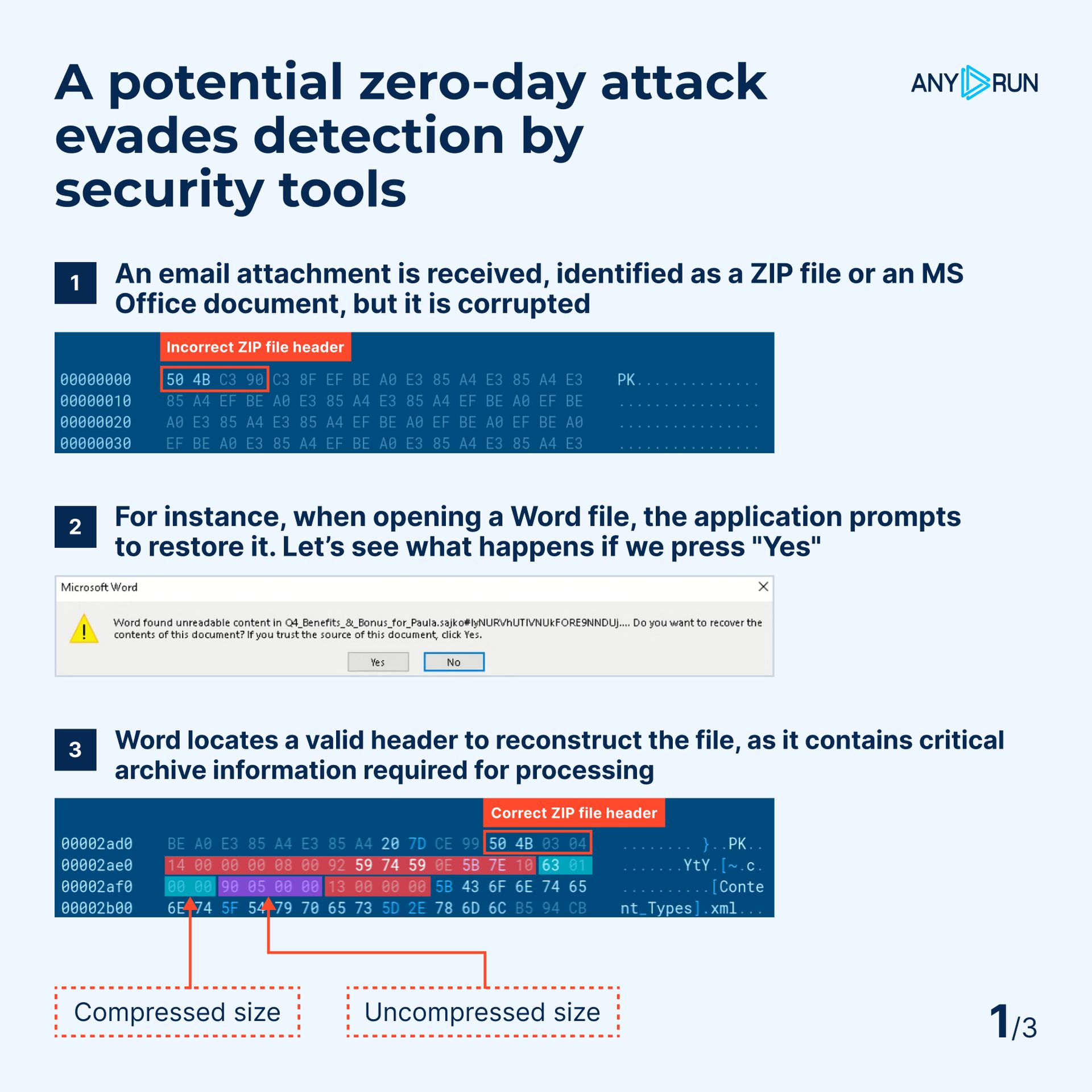
ANY.RUN reported that corrupted documents are crafted to slip past email filters and antivirus software, allowing phishing emails to reach targeted users. Unlike conventional malware, these files aren’t flagged as suspicious due to their corrupted state, which hinders scanning capabilities. The phishing campaign uses QR codes within documents to lead users to fraudulent Microsoft account login pages, mimicking legitimate communication regarding employee bonuses and benefits.

Samples of these documents, analyzed by ANY.RUN, showed that attachments delivered in this manner often yield no malicious flags when tested with VirusTotal. Scammers have developed corrupt documents specifically designed to evade content filters while maintaining enough integrity for Microsoft Word to recover them.

Stay Ahead of the Curve!

Don't miss out on the latest insights, trends, and analysis in the world of data, technology, and startups. Subscribe to our newsletter and get exclusive content delivered straight to your inbox.

The malicious files used in this campaign are designed to exploit the recovery functionalities of Microsoft Word and WinRAR. By manipulating the integrity of the files, attackers ensure that when users open these documents, the in-built recovery features make the files readable, thereby masking their malicious intent. This technique effectively allows attackers to bypass traditional scanning methods that many security software rely on.
How hackers are using corrupted Microsoft Office files to fool everyone
ANY.RUN reported that corrupted documents are crafted to slip past email filters and antivirus software (Image: ANY.RUN)

Investigations have identified this as a potential zero-day exploit, demonstrating a sophisticated understanding of software mechanics by threat actors. The goal remains clear: users are deceived into opening these corrupted files, leading to the activation of embedded QR codes that redirect them to fake websites designed to harvest credentials or deliver malware.

Security experts stress the importance of user awareness in the face of increasingly complex phishing attempts. Organizations must prioritize security awareness training, particularly for employees handling role-specific communications such as those about bonuses. Such training equips staff to recognize phishing attempts disguised as legitimate correspondence, reducing the risk of falling victim to these schemes.

Active measures to combat these threats include enhancing email filtering capabilities to detect patterns of file corruption or suspicious content that may not trigger traditional security alerts. In recent years, strategies such as blocking macros in Microsoft Office documents have been implemented to mitigate risks from similar methods of file exploitation. The continuous evolution of phishing tactics, such as embedding malicious links in QR codes, necessitates adaptive strategies from cybersecurity professionals and organizations alike.

The increasing prevalence of QR code phishing, also known as “quishing,” adds another layer of complication, with many users unaware of the risks associated with scanning codes. Cybersecurity solutions are becoming equipped with enhanced QR code detection measures, yet the sophistication of threats means potential vulnerabilities persist.


Featured image credit: Sasun Bughdaryan/Unsplash

Tags: CybersecurityMicrosoft

Related Posts

Meta debuts AI-powered Creator Studio app to help Facebook creators grow

Meta debuts AI-powered Creator Studio app to help Facebook creators grow

June 25, 2026
OpenAI unveils first custom inference chip named Jalapeño

OpenAI unveils first custom inference chip named Jalapeño

June 25, 2026
Figma adds code layers to collaborative design canvas

Figma adds code layers to collaborative design canvas

June 25, 2026
US reportedly urges Meta to submit AI models

US reportedly urges Meta to submit AI models

June 25, 2026
Euclid data could reveal isolated Milky Way black holes

Euclid data could reveal isolated Milky Way black holes

June 25, 2026
OpenAI upgrades GPT-5.5 Instant for stronger context awareness

OpenAI upgrades GPT-5.5 Instant for stronger context awareness

June 25, 2026

LATEST NEWS

Meta debuts AI-powered Creator Studio app to help Facebook creators grow

OpenAI unveils first custom inference chip named Jalapeño

Figma adds code layers to collaborative design canvas

US reportedly urges Meta to submit AI models

Euclid data could reveal isolated Milky Way black holes

OpenAI upgrades GPT-5.5 Instant for stronger context awareness

BEST AI MODELS LEADERBOARD

See the best AI models, ranked by intelligence, benchmark results, speed and token price. Find the most suitable LLMs, Text-to-Image, Image Editing, Text-to-Speech, Text-to-Video and Image-to-Video  artificial intelligence model for your tasks and business.

LATEST TOOLS

Vrew

Fireflies

SpeedLegal

Teachable Machine

Unriddle

VidAU

Qualified

character.ai

Interview Coder

Moonbeam

Dataconomy

COPYRIGHT © DATACONOMY MEDIA GMBH, ALL RIGHTS RESERVED.

  • About
  • Imprint
  • Contact
  • Legal & Privacy

Follow Us

  • News
    • Artificial Intelligence
    • Cybersecurity
    • DeFi & Blockchain
    • Finance
    • Gaming
    • Startups
    • Tech
  • Industry
  • Research
  • Resources
    • Articles
    • Guides
    • Case Studies
    • Whitepapers
    • AI Models Leaderboard
  • AI tools
  • Newsletter
  • + More
    • Glossary
    • Conversations
    • Events
    • About
      • Who we are
      • Contact
      • Imprint
      • Legal & Privacy
      • Partner With Us
No Result
View All Result
Subscribe

This website uses cookies to improve your experience. You can choose to accept or reject them. Visit our Privacy Policy.