Dataconomy
  • News
    • Artificial Intelligence
    • Cybersecurity
    • DeFi & Blockchain
    • Finance
    • Gaming
    • Startups
    • Tech
  • Industry
  • Research
  • Resources
    • Articles
    • Guides
    • Case Studies
    • Whitepapers
    • AI Models Leaderboard
  • AI toolsNEW
  • Newsletter
  • + More
    • Glossary
    • Conversations
    • Events
    • About
      • Who we are
      • Contact
      • Imprint
      • Legal & Privacy
      • Partner With Us
Subscribe
No Result
View All Result
  • AI
  • Tech
  • Cybersecurity
  • Finance
  • DeFi & Blockchain
  • Startups
  • Gaming
Dataconomy
  • News
    • Artificial Intelligence
    • Cybersecurity
    • DeFi & Blockchain
    • Finance
    • Gaming
    • Startups
    • Tech
  • Industry
  • Research
  • Resources
    • Articles
    • Guides
    • Case Studies
    • Whitepapers
    • AI Models Leaderboard
  • AI toolsNEW
  • Newsletter
  • + More
    • Glossary
    • Conversations
    • Events
    • About
      • Who we are
      • Contact
      • Imprint
      • Legal & Privacy
      • Partner With Us
Subscribe
No Result
View All Result
Dataconomy
No Result
View All Result

Saving Lives and Saving Money: The Heart Failure Risk-O-Meter

byEileen McNulty
July 15, 2014
in Artificial Intelligence, News
Home News Artificial Intelligence
Share on FacebookShare on TwitterShare on LinkedInShare on WhatsAppShare on e-mail
Google Preferred Source

Saving Lives and Saving Money The Heart Failure Risk-O-Meter

It’s often said (with a slight tone of disdain) that American hospitals are run like businesses. What better way then to improve efficiency and healthcare than with financial sticks-and-carrots?

This was the idea behind part of the Affordable Care Act, otherwise known as Obamacare. Heart failure re-admissions alone cost Medicare $15 billion a year, and the legislation aimed to change that. What they put in place was financial incentives if hospitals were able to slice re-admissions, and the removal of payment for treatment for hospitals whose readmission rates continued to soar. Estimates place the amount of re-admissions that are preventable between 20% and 75%. With financial incentives in place, so thought the legislative team, it might spark healthcare professionals to do something about this preventable problem.

Stay Ahead of the Curve!

Don't miss out on the latest insights, trends, and analysis in the world of data, technology, and startups. Subscribe to our newsletter and get exclusive content delivered straight to your inbox.

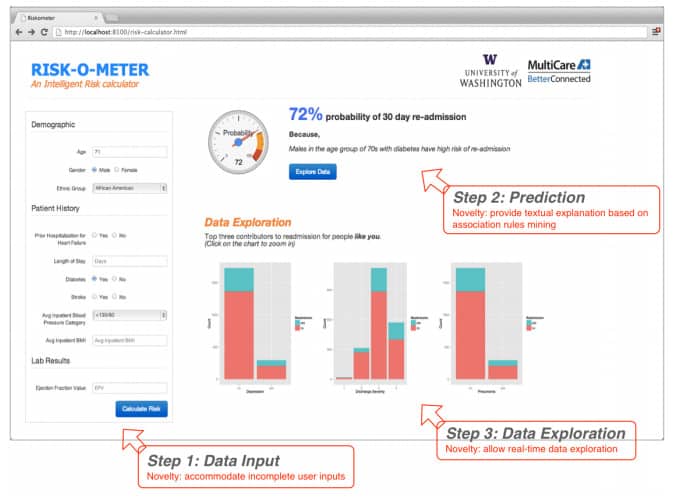
And they were right. Researchers at the University of Washington, Tacoma, developed a Risk-O-Meter powered by machine learning, and put it to the test in a hospital in Seattle. The Risk-O-Meter considers over 100 different metrics about a particular patient, ranging from obvious factors such as vitals to demographic information, and uses this data to assess how likely it is a patient will be re-admitted. It moves the focus on treating heart failure patients from treating the problem as it occurs, to hopefully preventing the need for re-admission altogether.

The Risk-O-Meter has thrown up a few surprising results. Firstly, as lead researcher Ankur Teredesai notes, “The chances of then getting readmitted are higher — much higher — if [patients] live alone. … The models actually show that.” Secondly, the amount of time Doctors keep patients in after heart failure might be ineffective. The standard time patients stay in hospital after heart failure is typically 13 days- the model shows the readmission risk is significantly reduced after 10 days, but spikes again at 13, right at the moment of medical discharge.

The system, Teredesai states, was constructed with privacy as a priority. No data is stored in the model itself; it’s simply input and then wiped when a risk score is calculated. The system was built on Microsoft Azure, which is HIPAA-compliant.

The future plan for the Risk-O-Meter is vague; the team are currently looking to commercialise their impressive and vital tool, either through the cloud or by starting their own company. We recently reported on how a New York hospital is using Machine Learning to make more accurate diagnoses in cardiac dysfunctions; one cannot help but wonder how powerful these two technologies could be if combined.

Read more here.
(Image credit: Risk-O-Meter)

Tags: healthcaremicrosoft azureUniversity of Washington

Related Posts

Why Telegram Mini Apps have become the optimal ecosystem for launching AI SaaS products

Why Telegram Mini Apps have become the optimal ecosystem for launching AI SaaS products

June 3, 2026
Crypto investors are watching one date closely in 2026

Crypto investors are watching one date closely in 2026

June 3, 2026
How Telegram Creators test post visibility before running growth campaigns

How Telegram Creators test post visibility before running growth campaigns

June 3, 2026
Does your AI clock in without you?

Does your AI clock in without you?

June 3, 2026
Why secure software delivery depends on better release management

Why secure software delivery depends on better release management

June 3, 2026
Sony reveals God of War: Laufey for PS5

Sony reveals God of War: Laufey for PS5

June 3, 2026
Please login to join discussion

LATEST NEWS

Why Telegram Mini Apps have become the optimal ecosystem for launching AI SaaS products

Crypto investors are watching one date closely in 2026

How Telegram Creators test post visibility before running growth campaigns

Does your AI clock in without you?

Why secure software delivery depends on better release management

Sony reveals God of War: Laufey for PS5

BEST AI MODELS LEADERBOARD

See the best AI models, ranked by intelligence, benchmark results, speed and token price. Find the most suitable LLMs, Text-to-Image, Image Editing, Text-to-Speech, Text-to-Video and Image-to-Video  artificial intelligence model for your tasks and business.

LATEST TOOLS

Veed.io

Paper Pilot

IsOn24

Magnific

DADABOTS

Rosebud AI

Prome

Pageon AI

Vyond

Centauri AI

Dataconomy

COPYRIGHT © DATACONOMY MEDIA GMBH, ALL RIGHTS RESERVED.

  • About
  • Imprint
  • Contact
  • Legal & Privacy

Follow Us

  • News
    • Artificial Intelligence
    • Cybersecurity
    • DeFi & Blockchain
    • Finance
    • Gaming
    • Startups
    • Tech
  • Industry
  • Research
  • Resources
    • Articles
    • Guides
    • Case Studies
    • Whitepapers
    • AI Models Leaderboard
  • AI tools
  • Newsletter
  • + More
    • Glossary
    • Conversations
    • Events
    • About
      • Who we are
      • Contact
      • Imprint
      • Legal & Privacy
      • Partner With Us
No Result
View All Result
Subscribe

This website uses cookies to improve your experience. You can choose to accept or reject them. Visit our Privacy Policy.