
Dataconomy
  • News
    • Artificial Intelligence
    • Cybersecurity
    • DeFi & Blockchain
    • Finance
    • Gaming
    • Startups
    • Tech
  • Industry
  • Research
  • Resources
    • Articles
    • Guides
    • Case Studies
    • Whitepapers
  • AI toolsNEW
  • Newsletter
  • + More
    • Glossary
    • Conversations
    • Events
    • About
      • Who we are
      • Contact
      • Imprint
      • Legal & Privacy
      • Partner With Us
Subscribe
No Result
View All Result
  • AI
  • Tech
  • Cybersecurity
  • Finance
  • DeFi & Blockchain
  • Startups
  • Gaming
Dataconomy
  • News
    • Artificial Intelligence
    • Cybersecurity
    • DeFi & Blockchain
    • Finance
    • Gaming
    • Startups
    • Tech
  • Industry
  • Research
  • Resources
    • Articles
    • Guides
    • Case Studies
    • Whitepapers
  • AI toolsNEW
  • Newsletter
  • + More
    • Glossary
    • Conversations
    • Events
    • About
      • Who we are
      • Contact
      • Imprint
      • Legal & Privacy
      • Partner With Us
Subscribe
No Result
View All Result
Dataconomy
No Result
View All Result

Data Science vs. the Tsetse Fly

byEileen McNulty
July 22, 2014
in Articles, News
Home Resources Articles
Share on FacebookShare on TwitterShare on LinkedInShare on WhatsAppShare on e-mail

The Niayes region near Dakar in Senegal has a serious pest problem. The pest in question is the tsetse fly, known to spread sleeping sickness to humans and enfeebling diseases to cows (a crucial part of Niayes’ agricultural industry). Past methods to drive the flies out have included drenching vast swathes of land in insecticides and the slaughter of rhinoceroses and hippopotamuses that could help the tsetse flies spread disease.

Their latest approach is more palatable, and more effective. An international research team have essentially recreated the environment virtually, using high-resolution maps and species distribution models to do so. The virtual environment helps them to locate where tsetse flies are most likely to be found. This information was given to the Pan African Tsetse and Trypanosomiasis Eradication Campaign, which helped them decide where to place poison traps and release sterilised male tsetse flies to disrupt breeding cycles.

“If you have better information on where the flies or the vectors are, you can specifically target those areas,” says Steven Peck, a biomathematician at Brigham Young University who visited Senegal several times to help develop the models. “One of the things that’s really promising is the use of GIS technology, where they use map-based approaches to recognize habitat using satellites. Having good maps and having good data, and then collecting data as you go, is absolutely going to change the whole game.”

Stay Ahead of the Curve!

Don't miss out on the latest insights, trends, and analysis in the world of data, technology, and startups. Subscribe to our newsletter and get exclusive content delivered straight to your inbox.

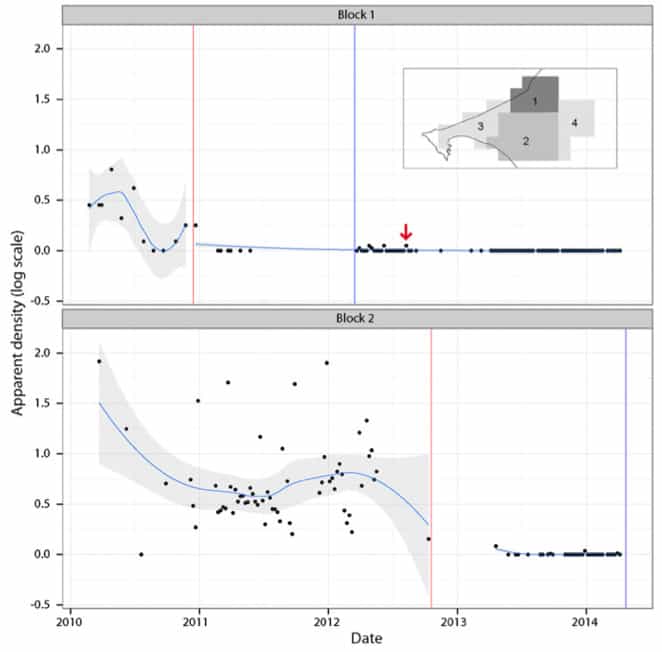
Modelling one 120,000-acre block of land, dubbed Block 2 by the research team, revealed tsetse flies could only inhabit 20,000 acres. These 20,000 acres were optimum temperature, and contained enough shade for the tsetse flies to rest in between their hunting trips for blood. With a much smaller area of land, the placement of traps and sterilised males became much more targeted.

The results of the initiative are shown in the chart below. The y axis is a logarithmic scale of tsetse fly density. The red lines denote when the poison traps were set, and the blue lines denote the release of the sterilised males. The red arrow on “Block 1” denotes the capture of the last wild fly.

Data Science vs. the Tsetse Fly

Read more here.
(Image credit: Flickr)

Tags: surveillance

Related Posts

Is Twitter down? Users report access issues as X won’t open

Is Twitter down? Users report access issues as X won’t open

January 16, 2026
Paramount+ raises subscription prices and terminates free trials for 2026

Paramount+ raises subscription prices and terminates free trials for 2026

January 16, 2026
Capcom reveals Resident Evil Requiem gameplay and February release date

Capcom reveals Resident Evil Requiem gameplay and February release date

January 16, 2026
Mother of one of Elon Musk’s children sues xAI over sexual Grok deepfakes

Mother of one of Elon Musk’s children sues xAI over sexual Grok deepfakes

January 16, 2026
Samsung revamps Mobile Gaming Hub to fix broken game discovery

Samsung revamps Mobile Gaming Hub to fix broken game discovery

January 16, 2026
Bluesky launches Live Now badge and cashtags in major update

Bluesky launches Live Now badge and cashtags in major update

January 16, 2026
Please login to join discussion

LATEST NEWS

Is Twitter down? Users report access issues as X won’t open

Paramount+ raises subscription prices and terminates free trials for 2026

Capcom reveals Resident Evil Requiem gameplay and February release date

Mother of one of Elon Musk’s children sues xAI over sexual Grok deepfakes

Samsung revamps Mobile Gaming Hub to fix broken game discovery

Bluesky launches Live Now badge and cashtags in major update

Dataconomy

COPYRIGHT © DATACONOMY MEDIA GMBH, ALL RIGHTS RESERVED.

  • About
  • Imprint
  • Contact
  • Legal & Privacy

Follow Us

  • News
    • Artificial Intelligence
    • Cybersecurity
    • DeFi & Blockchain
    • Finance
    • Gaming
    • Startups
    • Tech
  • Industry
  • Research
  • Resources
    • Articles
    • Guides
    • Case Studies
    • Whitepapers
  • AI tools
  • Newsletter
  • + More
    • Glossary
    • Conversations
    • Events
    • About
      • Who we are
      • Contact
      • Imprint
      • Legal & Privacy
      • Partner With Us
No Result
View All Result
Subscribe

This website uses cookies. By continuing to use this website you are giving consent to cookies being used. Visit our Privacy Policy.