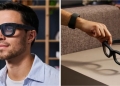
Taiwan’s HTC launched its VIVE Eagle AI smart glasses in Hong Kong in August 2025 to capture market share in the smartglasses sector through an open-platform strategy that lets users select AI models such as Google’s Gemini and OpenAI.
HTC positions the VIVE Eagle as an open device amid rapid AI advancements. Charles Huang, senior vice president of global sales and marketing at HTC, explained in a Reuters interview the rationale behind this approach. “AI is advancing very fast, and large language model developers are engaged in an arms race that requires massive resources,” Huang stated. He added, “We want to leverage the strengths of different platforms instead of building a closed ecosystem.” This design enables users to access improvements from various AI models without restriction to a single provider.
The VIVE Eagle smart glasses support multiple AI platforms, including Google’s Gemini and OpenAI. In comparison, Meta’s smart glasses rely on Meta AI, while Chinese brands such as Xiaomi and Alibaba integrate domestically developed AI models. HTC priced the VIVE Eagle at HK$3,988 ($512) for its Hong Kong debut earlier in August 2025. The glasses were displayed at HTC’s headquarters in Xindian, New Taipei City, Taiwan, on December 17, 2025.
HTC outlined specific expansion timelines for the VIVE Eagle. Sales will extend to Japan and Southeast Asia during the first quarter of 2026. Further rollout targets Europe and the United States later in 2026. This sequence prioritizes Asia before broader global markets.
The Asia-first rollout stems from design adaptations for regional users. Huang noted that many existing smart glasses accommodate a “Western fit” that does not align well with Asian wearers. HTC tailored the VIVE Eagle to address this mismatch, enhancing comfort and suitability for Asian markets.
Regarding potential entry into China, Huang highlighted regulatory hurdles. Foreign AI services face restrictions there, and local data regulations mandate standalone servers within the country. “With all these requirements in place, we need to be cautious and it will take some time to prepare,” Huang said. HTC approaches this market with deliberate preparation to comply fully.
Global smartglasses shipments rose 110% in the first half of 2025, according to research firm Counterpoint. Meta captured 73% of that market share during this period. The surge reflects growing demand for wearable AI-integrated eyewear.
Meta, in partnership with EssilorLuxottica, introduced its smart Ray-Bans and Oakleys in 2023. These devices handle functions such as answering calls, capturing pictures, and playing music, drawing widespread attention in the technology sector.
Analysts point to privacy as an emerging issue in the smartglasses market. Meta, which operates Facebook, Instagram, and WhatsApp, employs user data to develop its AI tools, prompting scrutiny over its data handling practices. HTC differentiates itself on this front. Huang stated that HTC does not use user data to train its AI models. The company views privacy and data security as primary distinctions from competitors.
The VIVE Eagle launch represents HTC’s renewed focus on consumer hardware. Earlier in 2025, HTC sold part of its extended reality headset and glasses unit to Google for $250 million. This transaction preceded the smart glasses initiative, signaling HTC’s strategic pivot back into direct consumer products.